Showing posts with label Pelican. Show all posts

Friday, 23 February 2018

A fortnight in the Caribbean - Part 4 and final,

My last reminiscences  about Nevis, see Part 1 - Part 2 and Part 3; here are a few more photos taken during our holiday.


Vance W. Amory International Airport on Nevis. It is only used for private aircraft, the main international flights all flying into the Robert L. Bradshaw International Airport on the neighbouring island of St Kitts, just a couple of miles across the water! When you land there, it is necessary to get a speedboat (fast, expensive but damp) or ferry (slow, cheaper but infrequent) to take you to Nevis.

Built in 1778, the Bath Hotel was once a playground for the rich and famous who came to Nevis to take in the hot spring baths. With the downturn of the sugar industry, Nevis stepped into the world of tourism with this hotel, which flourished for about 60 years. Since then the hotel has had various uses, reopening as a hotel from 1912 until 1940. It was used as a training centre for the West Indian regiment during World War II, and most recently, the temporary headquarters of the Nevis police, while the new station was built. (the old one was burnt down, I think, in mysterious circumstances!)

An old, but  now restored, cannon from the 17th or 18th century! This would either have been a part of the island's defences during one of the many wars in that era, or a cannon left behind after refitting of a visiting warship.

The royal cypher of one of the English kings named George. (GR stands for George Rex in Latin). There were three Georges in that era and I would guess this is the cypher for George III, who reigned in Great Britain between 1760 and 1820

View across to Nevis Peak; see part 2 for info on the old volcano.

Amazing views looking across to St Kitts.

Relaxing pool fed from volcanic hot springs.  While we were there, we had a couple of dips in the therapeutic waters; temperature varies slightly from day to day, but on those days it was 44°C (111°F)!  Not easy to get into, but once submerged to neck level, we managed to stay in for at least 5 minutes !!

Further information on the pool.

and some of the history - 108°F seems to be an understatement - perhaps it's global warming!

It was interesting for us to see a couple of baobab trees on the island.  We are of course fairly used to them in some areas of Africa. Both trees looked as if they had been inexpertly cut down or cut back at some stage long ago, as they had a number of branches growing out of the base.  Generally they have one big and thick trunk, sometimes many metres in circumference. Branches normally grow from the trunk a long way above the ground.

Here you can see the thick base at the bottom, with a number of branches growing out of it.

The pod from the baobab contains pips that are slightly sour and acidic. They  can be used as a replacement for cream of tartar.  The baobab is sometimes called a cream of tartar tree.

Driving to our next destination, we had to beware of goats wandering into the road; a common hazard. Also, just take a look at that frizzy wiring - scary stuff!!! But a note of progress - notice that solar panel on the bus stop roof!

Just off the main road are the ruins of New River-Coconut Walk Estates.

The tall boiler chimney is very visible, and the lower building  housed the old steam engine. In the 17th century, the sugar processing machines were driven by animal power,  but the industrial revolution eventually arrived here 150 years later! This suger production facility remained in operation until 1958—the last one on the island.

Underground, a mysterious space....

Machinery, bits of cane crushing rollers perhaps...

More cane-crushing machinery, now protected under a smart new corrugated iron roof. Restoration work on this site has partly been funded by the EU.

Nearby offices are sadly in a bad state of disrepair. The circular columns, stone arches and ceilings are quite elaborate for this industrial development, but a testament to the skills of expatriate British and local craftsmen!

This was the magnificent view that we saw daily from our friends' house, looking over to St Kitts!

I think this is an atmospheric optical phenomenon know as a "sun dog".  We were all lying by the pool when this was suddenly spotted.

To finish on an ornithological note, this is my collage of a brown pelican taking a dive into the sea to fish for its dinner!


I have a new blog purely for our feathered friends which is HERE


Also see my daily diary HERE


and My Life Before Charente (updated  February 2018) 


Tuesday, 6 February 2018

A fortnight in the Caribbean - Part 3 - and 8 years of blogging

It's 8 years today from my very first post, and the beginning of blogging! I now have a number of blogs and many new friends. I am delighted to say that I have met some followers personally, and each meeting has been a great experience; with the discovery of common attitudes and interests, I have no doubt that lifelong friendships will be formed.  For those followers  I have not yet been able to meet, many have become friends via personal email and others via chats on the blog.  Thank you, one and all, for being there and taking the time to read and comment; it is much appreciated!

Back to reminiscing about Nevis, see Part 1 and Part 2 and here are a few more photos taken during our holiday.
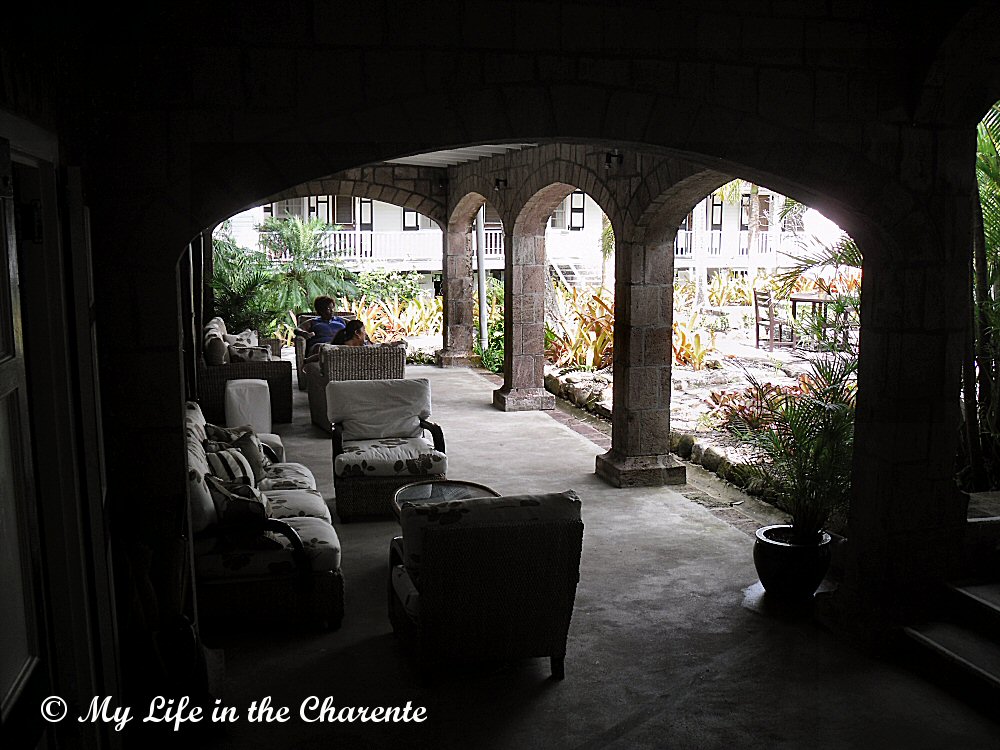
Taken in the grounds of the Montpelier hotel.  Montpelier was formerly a 17th century sugar estate, but the buildings now transformed to provide luxury and upmarket accommodation....

On the veranda.  This is where Princess Diana used to visit....

Cogwheels from the sugar cane crushing process reminding the visitor of what used to be here...

One of the lounges with a pub at the back, housing a great selection of drinks....

Nelson’s love affair with Nevis was largely due to Fanny Nisbet, a widow he met at a dinner party on Nevis. The two fell instantly in love, and their nuptials are without a doubt the most famous wedding here to date....


The house is no longer standing but the famous silk cottonwood tree, under which they got married, still is!

Moving on to another part of the island - nothing is very far away!  We arrive at the church of St Thomas, which we were told was the oldest Anglican church in the Caribbean.   The original church was built in 1643 and there are still a few old and broken gravestones in the churchyard (see below) from the 17th century....

It was closed up on the day we visited, so we did not get to see inside, but there are services on Sundays. There are loads of churches on the island, dedicated to all varieties of Christian faiths!

The churchyard overlooks the sea and the island of St Kitts in the distance.

The tourist signboard neatly describing the circumstances by which the church was founded and built, as a gift from English planter Thomas Cottle.

He was once the President of Nevis and a very benevolent slave owner, by the harsh and inhuman standards of the day, of course. This church was the only one on the island, and probably in the Caribbean, where the slaves and their master worshipped together. It was never consecrated, since it was illegal at that time for slaves to worship. The structure was severely damaged in a 1974 earthquake and again in 1989 during Hurricane Hugo. The building is still a primary tourist attraction and is presently undergoing restoration to stabilise it and ensure its historical significance for the future.


Inside the church; quite a modest building as you can see.

Part of a wall plaque recording the names and ages of some of the slaves who lived on the local  Round Hill estate and worked on the construction of the church. One child named Aaron is listed as aged only 4 and others are shown as having been born in Africa, obviously  being transported to the island as slaves.

Returning to some of the wildlife in Nevis!  Caribbean Queen or Jamaican Monarch butterfly (Danaus cleophile).

The panther anole (anolis bimaculatus), is a species of lizard that is endemic to the Caribbean Lesser Antilles islands.

African green, or “vervet” monkey (Chlorocebus aethiops).  These monkeys were first brought to the islands as pets in the 17th or 18th centuries. Some escaped or were set free and they have thrived ever since. They can be a nuisance, running off with food and anything else not nailed down!

Brown pelican (Pelecanus occidentalis) wheeling over the seashore, no doubt seeking fish in the shallows.

Mangrove Buckeye butterfly (Junonia genoveva) taking a break!


Watching the sun go down in  a local restaurant with St Kitts on the skyline.


Also see my daily diary HERE


and My Life Before Charente (updated  February 2018) 


Monday, 20 November 2017

Part 9 of our Southern African Holiday - in KwaZulu-Natal and Christmas Greetings

Continuing on from part 8, still with Gordon and Julie.....
As we approached the entrance gate of Mkhuze Game Reserve, which is situated in northern KwaZulu-Natal, we were thankful that Gordon's Toyota had 4 wheel drive! You can get an idea of how much rain had recently fallen, by the amount of floodwater crossing the road. That section of road is in concrete for a good reason!

Our accommodation for the night!  Sleeping quarters in the raised tent on the left and the kitchen on the right. Simple but effective!

Inside the tent now, with a shower and toilet through the bamboo cane decorated door on the left - all mod cons!

A night-time visitor to the kitchen, attracted by the prospect of food! There were quite a number of them in the trees around our tent. Bush babies (or Brown greater galago (Otolemur crassicaudatus) are mainly nocturnal, their large eyes giving them good night vision. Also they have strong hind limbs for leaping from tree to tree, acute hearing, and long tails that help them balance. Their bat-like ears  allow them to track insects in the dark;they catch them either on the ground or snatch them out of the air! Fascinating and incredibly agile animal!

"Do not feed the animals!" - not easy when there is a thief in our midst creeping into the kitchen!!!

Nyala male (Tragelaphus angasii). The handsome slate-brown shaggy coat is marked with white vertical stripes and spots on the flanks. Males (or Rams ) appear more charcoal-grey in colour and have long inward curved horns and a white chevroned face.....
  
The females are browner, do not have horns, and are very much smaller than the male.

Impala male (Aepyceros melampus) It is one of the most common and most graceful of all Africa’s antelopes. A slender, agile creature, it can clear formidable obstacles and run at speeds faster than 60km/h. Only the males have horns.

Trumpeter Hornbill (Bycanistes bucinator) It is a sociable bird, usually living in groups of two to five individuals, although sometimes as many as fifty. It is a locally common resident of the tropical evergreen forests. They eat fruit or large insects.

African helmeted turtle (Pelomedusa subrufa), also known as the marsh terrapin. They eat almost anything (!) including carrion and can be found throughout Africa in rivers, dams and lakes.


The white-faced whistling duck (Dendrocygna viduata). A common bird  that lives in large flocks.

Great White Pelican on the water (Pelecanus onocrotalus). This is an enormous waterbird, mostly white with short legs and a massive, broad and very long azure blue bill, which has a central red stripe and ends in a small, red hook. The mostly white bird has contrasting black flight feathers on the wings. Their diet is mainly fish, but they do feed on insects and small mammals as well.

Red-billed oxpecker (Buphagus erythrorhynchus) on a giraffe. They feed almost exclusively on ticks or insects collected from the skin of large African mammals.  See my previous posts for more information!

Blue Wildebeest also called gnu, a genus of antelopes, (Connochaetes taurinus). They generally congregate in herds and both sexes have horns, though the female is smaller  in size than the male.

African White-backed Vulture (Gyps africanus). It is very typical, with its bald head, broad wings and short tail.  Their main food source comprises dead animals around its habitat. They are on the endangered list, mainly because of urbanisation, poisoning and use of their body parts in witchcraft.

Yellow-throated longclaw (Macronyx croceus) is found in most of Africa.  Usually in pairs or small groups feeding off insects.

Burchell's Coucal (Centropus burchellii), is a species of cuckoo. This common resident of southern Africa is usually seen either as a solitary individual or in pairs, often making their way by clambering through the riverine or coastal bush. In this habitat they are often hard to see.The female lays 3 to 4 eggs and both male and female help with feeding the chicks. This bird has a very distinctive call, and it calls often before, during and just after heavy rain, thus its popular name of the Rainbird!

 Nile crocodile (Crocodylus niloticus) is the largest freshwater predator ... It is one of the most dangerous species of crocodile and is responsible for hundreds of human deaths every year.. .

The red-crested korhaan or red-crested bustard (Lophotis ruficrista) feeds on insects, seeds and fruit. They are usually solitary or in pairs and they can stand very still, relying on camouflage for concealment.  We were lucky that Gordon's sharp eyes saw this bird quite close to the gravel road.

Finally, the views all around in KwaZulu-Natal (the land of 1000 hills) are spectacular.

This covers most of our travel in Southern Africa, but I still have many photos that I may put on at a later date!!

Happy holidays
I would like to wish all my followers who celebrate Christmas the very 
best over the holidays!


I am going into blog hibernation until well into the New Year. We are off to see friends in Nevis for two weeks, then we will have a quiet Christmas in the UK with my FIL.  Meanwhile I will try to keep the PhotoDiary going when possible. 

Take care everyone; see you all after the holidays.