Showing posts with label vulture. Show all posts

Monday, 23 July 2018

Falconry at la Rochefoucauld

Apologies for not updating the blog for so long and this post has been copied over from my photodiary.  I thought that it also belonged here, as this really is part of My Life in the Charente and I know not everyone who follows this blog follows the diary.  I have a number of photos to go through that will eventually find their way here but I seem to always be running out of time!

The castles humble beginning dates back to year 980, from a wooden camp that was built by Foucauld on a rocky spur. The word ‘rock’, in fact, translates to ‘Roche’ in French. A square keep was then constructed by his son at the same site in the 11th century.
To celebrate the end of the Hundred Years’ War in 1453 and to demonstrate his political power as the Lord of the region, Jean de La Rochefoucauld built three additional towers to the structure and raised the level of the main tower of the castle, thus, enabling him to oversee his domain at greater heights. The last major modification to the overall structure of the castle was done in 1760 with the construction of the West Wing.
The Rochefoucauld family have owned and lived in the chateau for over 1000 years.  It is possible to view the chateau all except the wing where the family still live.

You can see they have reverted to the old name here. La Roche à Foucauld -The rock at Foucauld.

There was a lot of events going on but my only interest was the falconry.  I have more photos than usual but I did not want to split up the post.
Bald Eagle (Haliaeetus leucocephalus) from North America- just look at those eyes!!...


as above...


as above...


and in flight.


The commentary was all in French so it was not easy to follow, but they said this was a barn owl.  It looked too small to me but it is certainly from the same family.  Also, I did not know which country the birds had come from; my books only cover South Africa and Europe!  Any help here please would be appreciated.


As above...


As above...


As above.


This bird I did recognise as it is a Giant eagle-owl (Bubo lacteus). Africa’s largest eagle-owl.  It was quite noisy calling often, but they did not fly it while we were there.


I believe this to be a Harris's Hawk (Parabuteo unicinctus) that came from America...
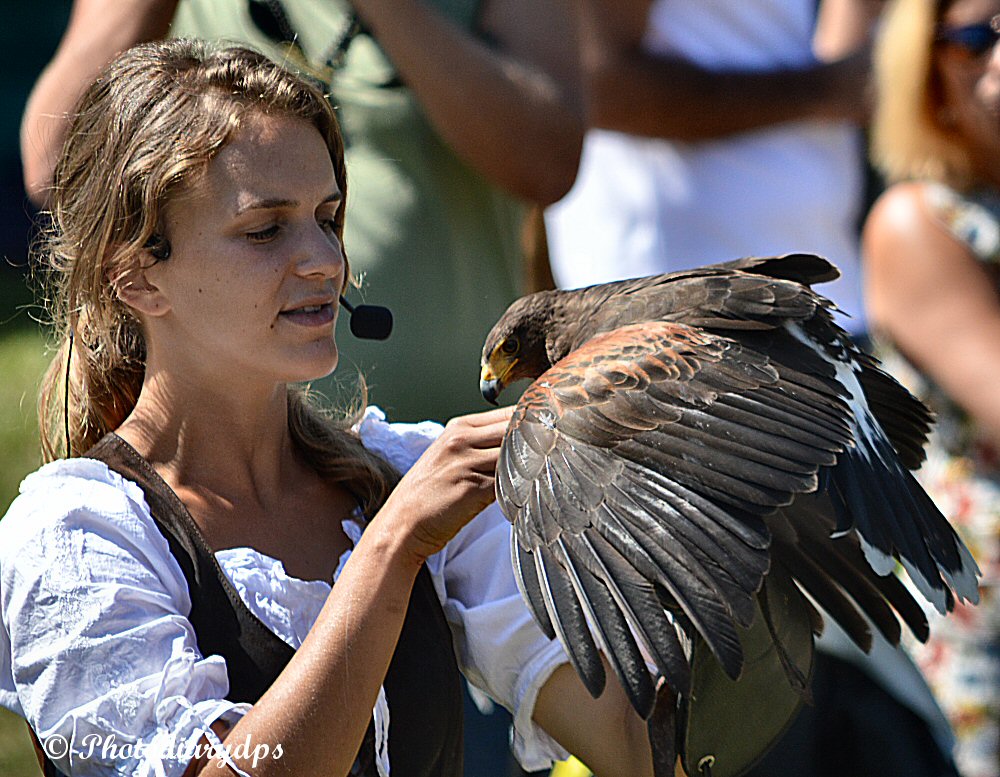

As above with the falconer.


Even I could not mistake this bird, the Kookaburra from Australia (Dacelo novaeguineae).  I must say it is the first time I have seen one flown in a falconry exhibition...


As above.


I think this might be a White-backed vulture (Gyps africanus). It is only two years old.


As above with the falconer...


As above - close up.


This might be a Hooded Vulture (Necrosyrtes monachus)...


As above with the falconer.  The birds were flying back and forth between the two falconers...


As above...


and finally a close up of the head of the above bird.


My birdblog is updated HERE

and my photodairy is HERE


Monday, 20 November 2017

Part 9 of our Southern African Holiday - in KwaZulu-Natal and Christmas Greetings

Continuing on from part 8, still with Gordon and Julie.....
As we approached the entrance gate of Mkhuze Game Reserve, which is situated in northern KwaZulu-Natal, we were thankful that Gordon's Toyota had 4 wheel drive! You can get an idea of how much rain had recently fallen, by the amount of floodwater crossing the road. That section of road is in concrete for a good reason!

Our accommodation for the night!  Sleeping quarters in the raised tent on the left and the kitchen on the right. Simple but effective!

Inside the tent now, with a shower and toilet through the bamboo cane decorated door on the left - all mod cons!

A night-time visitor to the kitchen, attracted by the prospect of food! There were quite a number of them in the trees around our tent. Bush babies (or Brown greater galago (Otolemur crassicaudatus) are mainly nocturnal, their large eyes giving them good night vision. Also they have strong hind limbs for leaping from tree to tree, acute hearing, and long tails that help them balance. Their bat-like ears  allow them to track insects in the dark;they catch them either on the ground or snatch them out of the air! Fascinating and incredibly agile animal!

"Do not feed the animals!" - not easy when there is a thief in our midst creeping into the kitchen!!!

Nyala male (Tragelaphus angasii). The handsome slate-brown shaggy coat is marked with white vertical stripes and spots on the flanks. Males (or Rams ) appear more charcoal-grey in colour and have long inward curved horns and a white chevroned face.....
  
The females are browner, do not have horns, and are very much smaller than the male.

Impala male (Aepyceros melampus) It is one of the most common and most graceful of all Africa’s antelopes. A slender, agile creature, it can clear formidable obstacles and run at speeds faster than 60km/h. Only the males have horns.

Trumpeter Hornbill (Bycanistes bucinator) It is a sociable bird, usually living in groups of two to five individuals, although sometimes as many as fifty. It is a locally common resident of the tropical evergreen forests. They eat fruit or large insects.

African helmeted turtle (Pelomedusa subrufa), also known as the marsh terrapin. They eat almost anything (!) including carrion and can be found throughout Africa in rivers, dams and lakes.


The white-faced whistling duck (Dendrocygna viduata). A common bird  that lives in large flocks.

Great White Pelican on the water (Pelecanus onocrotalus). This is an enormous waterbird, mostly white with short legs and a massive, broad and very long azure blue bill, which has a central red stripe and ends in a small, red hook. The mostly white bird has contrasting black flight feathers on the wings. Their diet is mainly fish, but they do feed on insects and small mammals as well.

Red-billed oxpecker (Buphagus erythrorhynchus) on a giraffe. They feed almost exclusively on ticks or insects collected from the skin of large African mammals.  See my previous posts for more information!

Blue Wildebeest also called gnu, a genus of antelopes, (Connochaetes taurinus). They generally congregate in herds and both sexes have horns, though the female is smaller  in size than the male.

African White-backed Vulture (Gyps africanus). It is very typical, with its bald head, broad wings and short tail.  Their main food source comprises dead animals around its habitat. They are on the endangered list, mainly because of urbanisation, poisoning and use of their body parts in witchcraft.

Yellow-throated longclaw (Macronyx croceus) is found in most of Africa.  Usually in pairs or small groups feeding off insects.

Burchell's Coucal (Centropus burchellii), is a species of cuckoo. This common resident of southern Africa is usually seen either as a solitary individual or in pairs, often making their way by clambering through the riverine or coastal bush. In this habitat they are often hard to see.The female lays 3 to 4 eggs and both male and female help with feeding the chicks. This bird has a very distinctive call, and it calls often before, during and just after heavy rain, thus its popular name of the Rainbird!

 Nile crocodile (Crocodylus niloticus) is the largest freshwater predator ... It is one of the most dangerous species of crocodile and is responsible for hundreds of human deaths every year.. .

The red-crested korhaan or red-crested bustard (Lophotis ruficrista) feeds on insects, seeds and fruit. They are usually solitary or in pairs and they can stand very still, relying on camouflage for concealment.  We were lucky that Gordon's sharp eyes saw this bird quite close to the gravel road.

Finally, the views all around in KwaZulu-Natal (the land of 1000 hills) are spectacular.

This covers most of our travel in Southern Africa, but I still have many photos that I may put on at a later date!!

Happy holidays
I would like to wish all my followers who celebrate Christmas the very 
best over the holidays!


I am going into blog hibernation until well into the New Year. We are off to see friends in Nevis for two weeks, then we will have a quiet Christmas in the UK with my FIL.  Meanwhile I will try to keep the PhotoDiary going when possible. 

Take care everyone; see you all after the holidays.