Showing posts with label butterfly. Show all posts

Tuesday, 6 February 2018

A fortnight in the Caribbean - Part 3 - and 8 years of blogging

It's 8 years today from my very first post, and the beginning of blogging! I now have a number of blogs and many new friends. I am delighted to say that I have met some followers personally, and each meeting has been a great experience; with the discovery of common attitudes and interests, I have no doubt that lifelong friendships will be formed.  For those followers  I have not yet been able to meet, many have become friends via personal email and others via chats on the blog.  Thank you, one and all, for being there and taking the time to read and comment; it is much appreciated!

Back to reminiscing about Nevis, see Part 1 and Part 2 and here are a few more photos taken during our holiday.
Taken in the grounds of the Montpelier hotel.  Montpelier was formerly a 17th century sugar estate, but the buildings now transformed to provide luxury and upmarket accommodation....
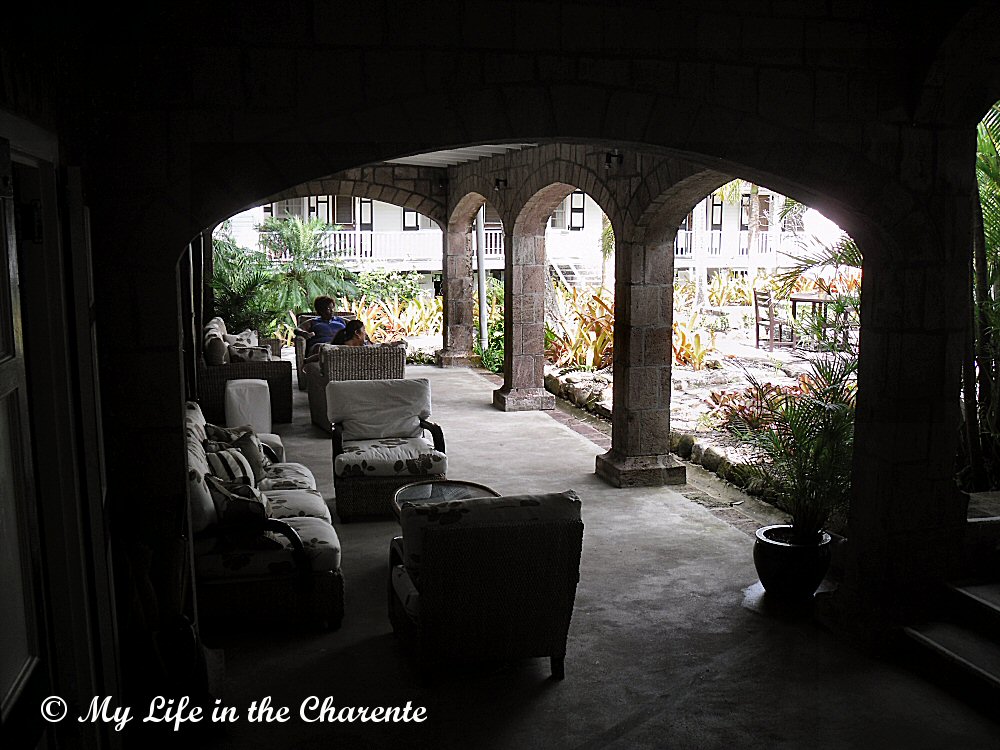
On the veranda.  This is where Princess Diana used to visit....

Cogwheels from the sugar cane crushing process reminding the visitor of what used to be here...

One of the lounges with a pub at the back, housing a great selection of drinks....

Nelson’s love affair with Nevis was largely due to Fanny Nisbet, a widow he met at a dinner party on Nevis. The two fell instantly in love, and their nuptials are without a doubt the most famous wedding here to date....


The house is no longer standing but the famous silk cottonwood tree, under which they got married, still is!

Moving on to another part of the island - nothing is very far away!  We arrive at the church of St Thomas, which we were told was the oldest Anglican church in the Caribbean.   The original church was built in 1643 and there are still a few old and broken gravestones in the churchyard (see below) from the 17th century....

It was closed up on the day we visited, so we did not get to see inside, but there are services on Sundays. There are loads of churches on the island, dedicated to all varieties of Christian faiths!

The churchyard overlooks the sea and the island of St Kitts in the distance.

The tourist signboard neatly describing the circumstances by which the church was founded and built, as a gift from English planter Thomas Cottle.

He was once the President of Nevis and a very benevolent slave owner, by the harsh and inhuman standards of the day, of course. This church was the only one on the island, and probably in the Caribbean, where the slaves and their master worshipped together. It was never consecrated, since it was illegal at that time for slaves to worship. The structure was severely damaged in a 1974 earthquake and again in 1989 during Hurricane Hugo. The building is still a primary tourist attraction and is presently undergoing restoration to stabilise it and ensure its historical significance for the future.


Inside the church; quite a modest building as you can see.

Part of a wall plaque recording the names and ages of some of the slaves who lived on the local  Round Hill estate and worked on the construction of the church. One child named Aaron is listed as aged only 4 and others are shown as having been born in Africa, obviously  being transported to the island as slaves.

Returning to some of the wildlife in Nevis!  Caribbean Queen or Jamaican Monarch butterfly (Danaus cleophile).

The panther anole (anolis bimaculatus), is a species of lizard that is endemic to the Caribbean Lesser Antilles islands.

African green, or “vervet” monkey (Chlorocebus aethiops).  These monkeys were first brought to the islands as pets in the 17th or 18th centuries. Some escaped or were set free and they have thrived ever since. They can be a nuisance, running off with food and anything else not nailed down!

Brown pelican (Pelecanus occidentalis) wheeling over the seashore, no doubt seeking fish in the shallows.

Mangrove Buckeye butterfly (Junonia genoveva) taking a break!


Watching the sun go down in  a local restaurant with St Kitts on the skyline.


Also see my daily diary HERE


and My Life Before Charente (updated  February 2018) 


Sunday, 5 November 2017

Part 8 of our Southern African Holiday - in KwaZulu-Natal

We left Joan's place on the south coast  to drive up to Pietermaritzburg, where we were meeting my great friend Gordon, who I  have known for at least 50 years, although I hate to admit it (!). We first met when we both worked at the Veterinary Research Laboratory in what was then Salisbury, Rhodesia.
Driving along the scenic south (of Durban) coastal road, almost all one sees are endless fields of sugar cane. South Africa produces 19.9 million tons of sugar cane a year, and most of it comes from the rolling green valleys of KwaZulu-Natal. If you should be interested you can find more about it HERE; it's an interesting site.


This drive was quite short; after the one in Part 7, just a short hop!  A relaxing drive of  2 ½ hours, mostly on dual carriageways, in light weekend traffic brought us to Pietermaritzburg.  We had a day's rest there, before we were again back on the road  with Gordon and his partner Julie, heading for Gordon's sister's home near Empangeni.

The amazing views driving through the "1000 hills" of Kwa-Zulu-Natal.


Arriving at Empangeni, we discovered that Gordon's sister Heather and brother-in-law Eric have the most amazing hillside property situated in a private game park!  We sat on their elevated balcony, with a beer in hand, watching these giraffe at the bottom of the garden!  There are very few places in the world where you could experience this sort of life!


Walking around their unfenced garden, keeping an eye out for large wild animals (!) , I saw this Long-tailed Blue butterfly (Lampides boeticus)...

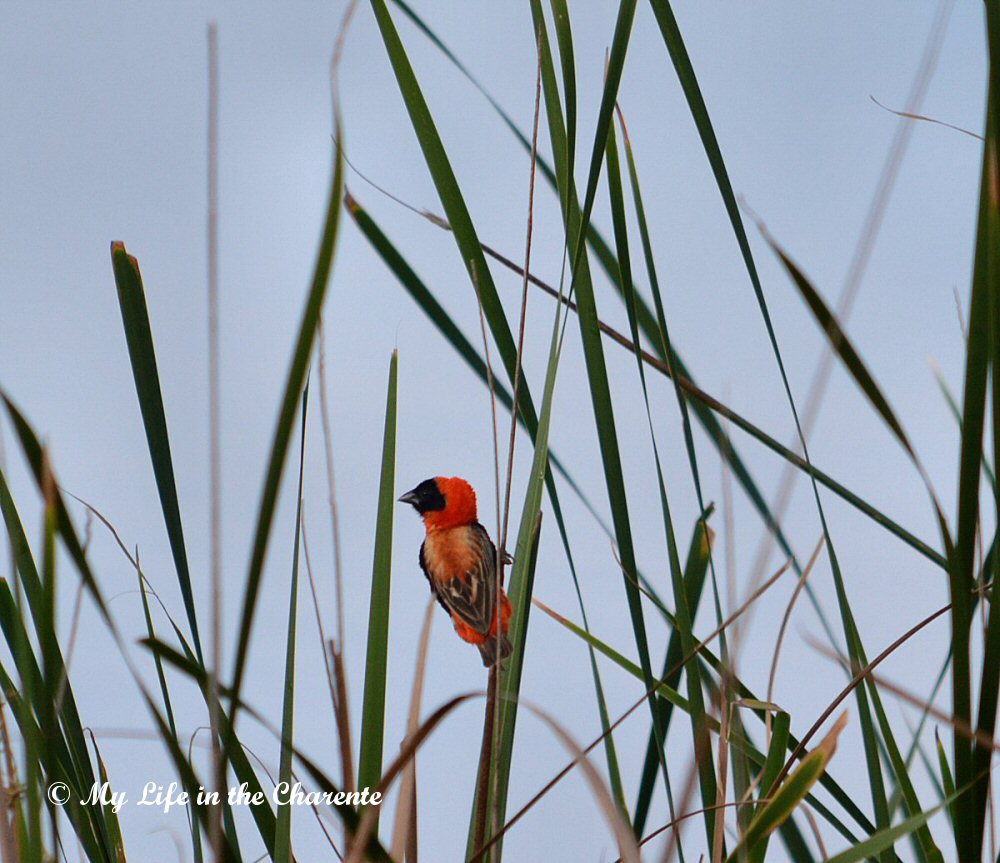
and a Southern red bishop bird (Euplectes orix).  This was one of the birds that was on my wish list to see again (I love them) and this was the only one I saw!


After a drink on the balcony, we all headed down to the riverside to have an evening braai (better known outside Africa as a barbecue!).  The fire was behind the cold box (sorry) but it was one of the few photos I had of Julie, Gordon and Nigel all together in the centre of the photo, with Eric seated on the right.

Meanwhile, in the river right behind Nigel and Gordon, were these very noisy hippos. (Hippopotamus amphibius).   As I have mentioned before, the world's largest, angriest animal, and one of the most dangerous.  There are no lion around these parts, but you need to be watchful for the occasional leopard, which I regret we did not see!

Moving onwards the following day and heading on to Bush Baby Lodge (owned by friends of Gordon) for the night, we saw this bird of prey, an African harrier-hawk, or gymnogene (Polyboroides typus) as it is better known. Gordon is an exceptional wildlife spotter, amazing at sightings and identification, a talent which made our lives very easy! 

Stopping along the way for a meal;  all "mod cons" in Gordon's Toyota 4x4 and that extra bit on the roof is a tent!!

Nigel and Julie at the back of the vehicle.  The box on the left is a deep freeze/ fridge combination; very useful when travelling in the bush!

We spent one night at Bush Baby Lodge (just off this map, but would be top right, beyond where Memorial Gate is shown), then the following day driving though Umfolozi and Hluhluwe game reserves.The whole of Kwa-Zulu Natal  province is shown at top left on the map with large scale detail of these game reserves. There had been a lot of rain in the area and game watching on the unsurfaced bush trails in a 2-wheel drive was definitely not recommended!

A cicada seen at Bush Baby Lodge. There are about 150 different species in South Africa, so I am not going to try to identify it further! They are extremely noisy; the high-pitched song is actually a mating call, belted out by the males. The sound is very complex and if you want to know how they make it, then click HERE which should help you to understand!

During the day, we saw few larger animals but lots of birds. Here is a European roller  (Coracias garrulus)  wintering in Natal.  It will head back to Europe to breed in summer.

Impala (Aepyceros melampus) making a face 😉 I guess really it is chewing its food.   The impala is able to change its eating habits with the seasons, depending on what is available in the near surroundings. Impala like to graze on fresh grass, but will also nibble on shoots and foliage when there is no grass growing nearby.

Two very young Zebra foals.  (Equus quagga, formerly Equus burchelli). Apparently no two zebras are the same; their stripes come in different patterns, unique to each individual.

Mocking cliff-chat; male.  The female is brown.  (Thamnolaea cinnamomeiventris).  This bird inhabits rocky and boulder strewn areas, well-wooded rocky ravines, and watercourses in valley bottoms with scattered rocks.   Mainly insectivorous, but they also eat fruit, and feed on the nectar of aloes.

Pied crow (Corvus albus).  It is a monogamous bird, which means that the bird finds and breeds with one partner for the rest of its life. The bird lays between 1 to 7 eggs, which are green in colour.  The nest is built high up in the tree canopy and is protected from predators by branches and the dense green foliage.  They are cheeky birds and can be quite noisy.

Spotted thick-knee also known as the Spotted dikkop or Cape thick-knee, (Burhinus capensis).  This bird can reach up to 45.5 cm (17.9 in) in height, has long legs and brown and white speckled plumage which provides fantastic camouflage.   It hunts and nests exclusively on the ground, feeding on insects, small mammals and lizards.


Steppe buzzard (Buteo vulpinus) which is a migratory bird of prey and one of the most common species of raptor in southern Africa during the summer months.


African or Cape buffalo (Syncerus caffer) cooling down in a mud puddle.  Due to the heavy rains, there were plenty of those around.

Not the best photo, but the only one of a tortoise that I managed to get!  I am not certain which one this is, but several of the species are critically endangered.  I feel I was lucky to get any photo at all.

A warthog family (Phacochoerus africanus).  Although covered in bristly hairs, their bodies and heads appear largely naked from a distance, with only the crest along the back, and the tufts on their cheeks and tails being obviously haired.

A white rhino, also cooling off in a small mud puddle,   When the mud is dry, the animal will scratch itself energetically against a tree stump or trunk to get rid of parasites. Rhinos also wallow in mud to protect their skin from the sun and to cool off.

 A yellow-billed kite (Milvus aegyptius), another of the most common birds of prey on the African continent.

Banded groundling (Brachythemis leucosticta) is a common dragonfly that occurs over most of South Africa.

Not a sign often seen, particularly outside Africa 😊. The "big five" game animals are the lion, leopard, rhinoceros , elephant, and Cape buffalo as seen here and all can be dangerous!

European bee-eater (Merops apiaster).  This bird breeds in open country in warmer climates. As the name suggests, bee-eaters predominantly eat insects, especially bees, wasps, and hornets, which they catch in flight.  Before eating a bee, the European bee-eater removes the sting by repeatedly hitting the insect on a hard surface.

Still more African images to come, as Gordon takes us further into the delights of the KwaZulu-Natal game parks.


Also see my daily diary HERE


and My Life Before Charente (updated  25 September 2016) I will get back to this eventually! 

Tuesday, 17 October 2017

Part 6 of our Southern African holiday, still in Botswana.

On the morning we left Kasane River View Lodge, (see parts 3, 4 and 5) we had a short drive ahead of us, (about 200 km or 125 miles) to our planned two night stop at Elephant Sands game park on our way back to Mahikeng in South Africa. More about the place later on!
Cruising southwards along the almost empty tarmac ribbon, Patrick's observant eyes suddenly spotted several of the rare Southern ground hornbills (Bucorvus leadbeateri) by the roadside...


Despite the fact that their name sounds as if the live on the ground, they do in fact fly, (as you can see above!) and also roost in trees.  This hornbill is the largest in the world, featuring striking red facial and throat skin which contrasts with its black plumage.  It has a wing span of 120 to 180 cm (4 to 6 feet) and it is on the endangered list. It is long-lived, apparently reaching 50 or even 60 years old.  It has a varied diet, mainly consisting of insects found on the ground.  They lay only two eggs, of which only one chick generally survives.  They do not breed very often; spaced anywhere from a few years up to at least nine years. So that might explain the rarity!

Arriving at Elephant Sands, we found the roads were quite wet and there was much mud around. It was the rainy season after all, but there had been exceptionally heavy falls in the two months before we arrived.

A warthog, having just got up from having a very welcome mud bath.  The mud cools them (they do not have sweat glands) and it also removes ticks and other skin parasites, which then become embedded in the mud.


Mum and baby.  Common warthog, (Phacochoerus africanus), is a wild member of the pig family that lives in grassland, savanna, and woodland.

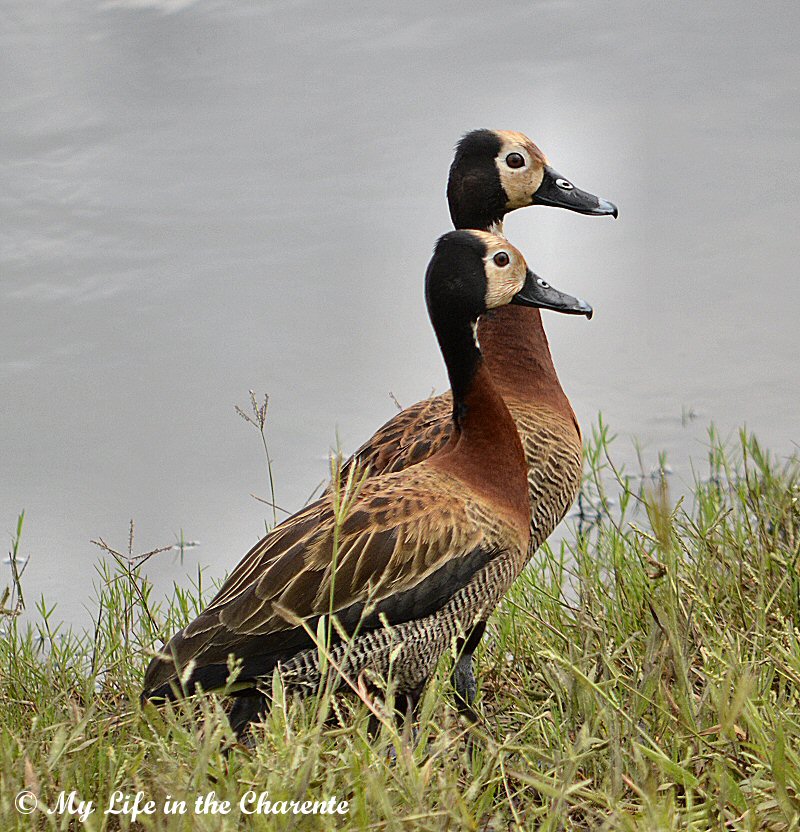
The white-faced whistling duck (Dendrocygna viduata)  breeds in sub-Saharan Africa and also in much of South America.  At night, the birds fly to foraging areas to feed on a varied diet that includes grass, seeds and aquatic molluscs, by wading, swimming or diving. 

The yellow-billed oxpecker, (Buphagus africanus), is from the starling and myna family.  It feeds exclusively from the backs of large mammals, eating ticks and insects on their hides.  As with the tick birds in my last post, it is good for the animals and provides food for the birds, a win-win arrangement!

African three-banded lapwing (previously known as a plover) (Charadrius tricollaris).  It lives near water, feeding on land and aquatic insects and their larvae, crustaceans, small molluscs and worms.


As the name of the resort suggests, there are plenty of elephants to see in the open landscape. The safari tent accommodation is placed around a large waterhole, so the elephants can  freely come in very close to drink and bathe;  care must be taken to keep out of their way!  You can see  one of the safari cabins on stilts in the background.  We were sitting in the relative safety of the main lodge building, taking these photos with a long lens!

As close as I ever want to get!!!  Eyelashes of the African elephant (Loxodonta africana).

We each had a safari tent; here are Christelle and Patrick on their balcony.   We both slept like logs while here, but Patrick was up and about in the middle of the night, and on his balcony, taking videos of elephants very close by!   Brave, or a little mad, I am not sure which!!!!

Christelle, Patrick and Nigel in the heat of the day, relaxing with a cool drink....

from the bar opposite.  The pool was perfect for cooling off from time to time.

The elephants mostly arrived later in the day and into the evening, looking for water to drink and to cool off in.

Getting the fire ready to barbecue our dinner.  No fences anywhere here, so we were keeping a watchful eye out for large intruders; thankfully they left us alone.  The elephants and all game have total freedom and can wander anywhere, which they do!

Another amazing African sunset.

The next morning, we were greeted by a glossy starling (Lamprotornis  genus). There are a number of very similar starlings and I am not sure which one this is.  In low light these birds appear to be almost black, but in the right light they radiate the most spectacular array of blues, greens and magenta. However, there are no pigments in the feathers that give rise to these colours. It is simply a trick of the light!

Red-billed teal. (Anas erythrorhyncha).   This duck is not migratory, but will fly great distances to find suitable waters.  Very common.

 Rock pigeon (Columba livia). Feeds mainly on seeds, rarely eating fruits and leaves. It typically forages on the ground, usually on farmland, lawns or roads.  Also very common!

Early morning stroll, having taken a bath.  Note he has his trunk resting on his tusks; guess it gets a little heavy to carry around all day!

Giraffe (Giraffa) A newborn giraffe is about 1.9 meters tall (6 feet) at birth and weighs about 68 kilograms (150 pounds). Fully grown giraffes stand 4.3–5.7 m (14.1–18.7 ft) tall.​ Males are taller than the females. I have given more information in some of the previous giraffe photos.

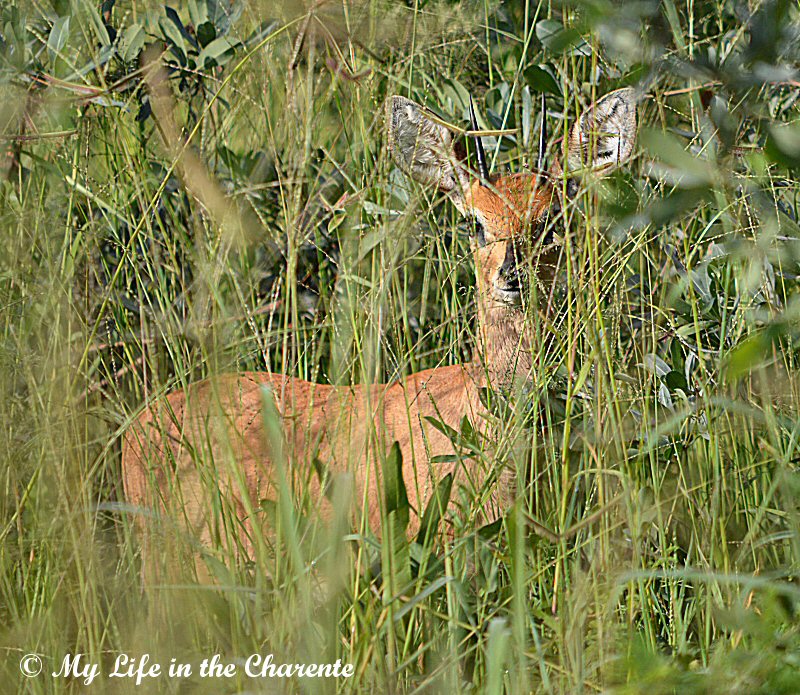
Steenbok (Raphicerus campestris).  A small common antelope which is only about 60cm (2 feet) high at the shoulders.  Mostly solitary but occasionally they will pair for life.  Visitors will often think that they are babies as they are so small!!


Various mix of butterflies, the one with open wings is (I think) Small grass yellow (Eurema brigitta), and the white and orange one could be the Bushveld orange tip (Colotis pallene).  If anyone can help with identifications, I would be delighted as I am not a lepidopterist!


The white-browed sparrow-weaver (Plocepasser mahali).  Found in groups of two to about eleven individuals including only one breeding pair. One dominant male and female; the remainder are helpers! They build a number of untidy looking nests that look like a bunch of straw; inside is soft grass, feathers and woolly type material. The breeding nest has only one entrance while the roosting nests have two entrances.  The babies are fed by all the birds in the colony. Co-operation at its best!


Also see my daily diary HERE


and My Life Before Charente (updated  25 September 2016) I will get back to this eventually!