Showing posts with label Vervet monkey. Show all posts

Tuesday, 6 February 2018

A fortnight in the Caribbean - Part 3 - and 8 years of blogging

It's 8 years today from my very first post, and the beginning of blogging! I now have a number of blogs and many new friends. I am delighted to say that I have met some followers personally, and each meeting has been a great experience; with the discovery of common attitudes and interests, I have no doubt that lifelong friendships will be formed.  For those followers  I have not yet been able to meet, many have become friends via personal email and others via chats on the blog.  Thank you, one and all, for being there and taking the time to read and comment; it is much appreciated!

Back to reminiscing about Nevis, see Part 1 and Part 2 and here are a few more photos taken during our holiday.
Taken in the grounds of the Montpelier hotel.  Montpelier was formerly a 17th century sugar estate, but the buildings now transformed to provide luxury and upmarket accommodation....
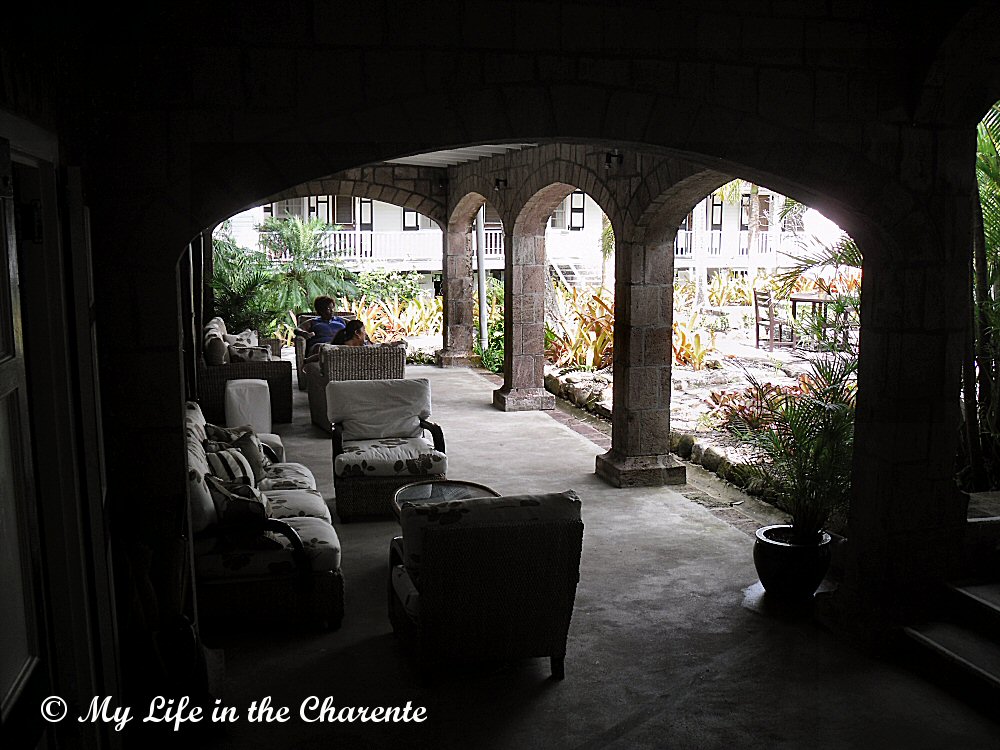
On the veranda.  This is where Princess Diana used to visit....

Cogwheels from the sugar cane crushing process reminding the visitor of what used to be here...

One of the lounges with a pub at the back, housing a great selection of drinks....

Nelson’s love affair with Nevis was largely due to Fanny Nisbet, a widow he met at a dinner party on Nevis. The two fell instantly in love, and their nuptials are without a doubt the most famous wedding here to date....


The house is no longer standing but the famous silk cottonwood tree, under which they got married, still is!

Moving on to another part of the island - nothing is very far away!  We arrive at the church of St Thomas, which we were told was the oldest Anglican church in the Caribbean.   The original church was built in 1643 and there are still a few old and broken gravestones in the churchyard (see below) from the 17th century....

It was closed up on the day we visited, so we did not get to see inside, but there are services on Sundays. There are loads of churches on the island, dedicated to all varieties of Christian faiths!

The churchyard overlooks the sea and the island of St Kitts in the distance.

The tourist signboard neatly describing the circumstances by which the church was founded and built, as a gift from English planter Thomas Cottle.

He was once the President of Nevis and a very benevolent slave owner, by the harsh and inhuman standards of the day, of course. This church was the only one on the island, and probably in the Caribbean, where the slaves and their master worshipped together. It was never consecrated, since it was illegal at that time for slaves to worship. The structure was severely damaged in a 1974 earthquake and again in 1989 during Hurricane Hugo. The building is still a primary tourist attraction and is presently undergoing restoration to stabilise it and ensure its historical significance for the future.


Inside the church; quite a modest building as you can see.

Part of a wall plaque recording the names and ages of some of the slaves who lived on the local  Round Hill estate and worked on the construction of the church. One child named Aaron is listed as aged only 4 and others are shown as having been born in Africa, obviously  being transported to the island as slaves.

Returning to some of the wildlife in Nevis!  Caribbean Queen or Jamaican Monarch butterfly (Danaus cleophile).

The panther anole (anolis bimaculatus), is a species of lizard that is endemic to the Caribbean Lesser Antilles islands.

African green, or “vervet” monkey (Chlorocebus aethiops).  These monkeys were first brought to the islands as pets in the 17th or 18th centuries. Some escaped or were set free and they have thrived ever since. They can be a nuisance, running off with food and anything else not nailed down!

Brown pelican (Pelecanus occidentalis) wheeling over the seashore, no doubt seeking fish in the shallows.

Mangrove Buckeye butterfly (Junonia genoveva) taking a break!


Watching the sun go down in  a local restaurant with St Kitts on the skyline.


Also see my daily diary HERE


and My Life Before Charente (updated  February 2018) 


Wednesday, 17 January 2018

A fortnight in the Caribbean - Part 1

We have friends who live on Nevis (there are twin islands - St Kitts and Nevis) and who have asked us a number of time to visit.  We though that a trip before braving the cold of the UK this past Christmas would be a good idea!  We duly booked the trip early last year, not realising that the Caribbean would be having some of their worst weather for a long time during the (summer) hurricane season.  Hurricanes Irma and Maria caused total destruction on many islands, and at one stage we thought we might never get there.  Luckily, Nevis missed the worst of it all; the damage to our friends' property was thankfully confined to their front gates being blown down and a few missing roof tiles.

We drove directly from home in France to London (Gatwick) airport  on 24 November 2017 and then the following day, we took an early morning flight to St Kitts, stopping for one hour on Antigua (where most of the passengers disembarked!).  On arrival at St Kitts airport, we were met by a taxi, which took us to the quay, where a water taxi, skimming wave crests at high speed,   carried us over the waters to Nevis in 15 energising minutes!  The taxi pilot kindly phoned ahead to our friends, to let them know we were on our way so they would be ready to meet us. Very organised!
Just to give you some idea where St Kitts and Nevis are in the Caribbean, if you did not previously know! Most of the other islands on this map were very badly affected by hurricanes and outside help and reparation is slow in arriving.

The island of Nevis, which is separated from St Kitts by a 3 km (2 miles) channel. It is only 93 sq km in size (36 sq mi) and the capital is Charlestown; you can see the "by-pass" road around the town on the West coast.

We arrived fairly late in the afternoon and the photos  taken from the ferry were not the best!

The next morning, though, after a good nights sleep, I was delighted to see many enchanting humming birds zooming around in the garden.This is a Green-throated carib (Eulampis holosericeus), motionless for just a moment!

The bees looked much the same as those we have in France!

We went for a walk through a strip of trees and bushes down to the nearby sandy beach; it was very quiet and peaceful with almost nobody else around!

Looking across the water towards St Kitts.

We spotted a hermit crab on the sand.

Back at the house, we discovered vervet monkeys in the garden - lovely to see, but they do a lot of damage!

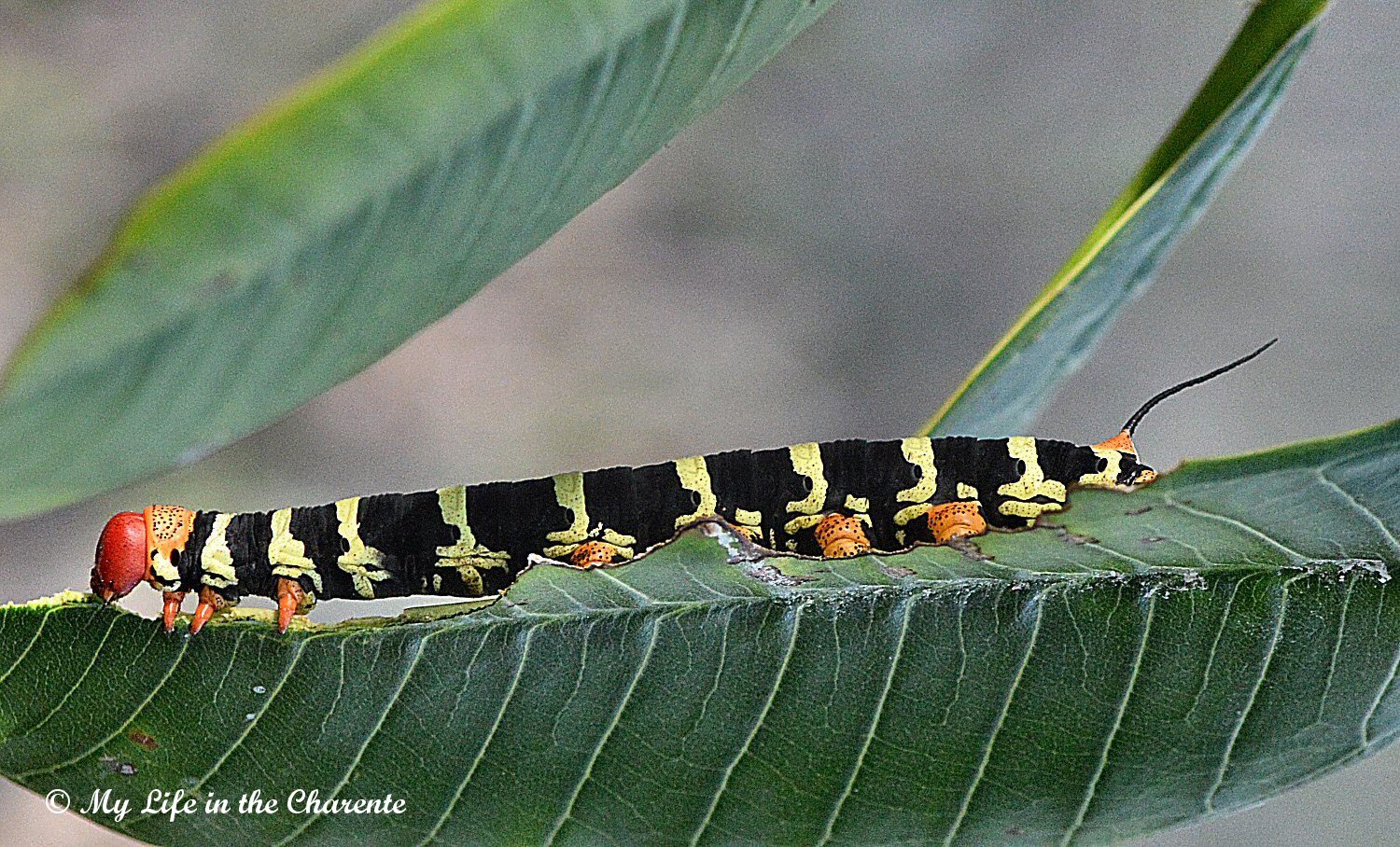
The very colourful Frangipani caterpillar (this one's 120 mm or 5 inches long), of which there were several on one plant, eats most of the plant's leaves, but we were told they actually do the plant good, as by eating the leaves, the plant's  encouraged to produce more flowers!

Lovely to see hibiscus flowering in November!

The garden was full of birds I have never seen before!; this is a Bananaquit (Coereba flaveola).

Lesser Antillean bullfinch (Loxigilla noctis) This is the male; the female is brown.

Out on our first drive around the island (maximum speed limit 40 mph!), we were told this is one of the original old houses, called a "skirt and blouse" house.  The skirt (bottom of the house) being built of stone and the blouse (top of the house) of wood.

 One of the most noticeable things we observed on the island were the many scrap cars! There is nowhere to dump them on a small island, so they are just abandoned by their owners for the vegetation to take over!

As above. There are plans for a private company to import and operate a car crushing plant, as the numbers of such cars must run into many thousands and apart from being unsightly, further damage to this beautiful tropical environment should  be avoided!

We ended up in late afternoon down at the beach, where we met up with friends of our friends, for a delightful meal of fresh fish of the day.  It was interesting to watch the storm in the distance over the sea, while we were standing on the beach, in temperatures around 30 C  (86F)

This is just to give you a first idea of our holiday.  Many more photos of the island are to come in Part 2, but due to me not feeling well,  I am far behind in the editing process!


Also see my daily diary HERE


and My Life Before Charente (updated  25 September 2016) I will get back to this eventually! 


Monday, 30 October 2017

Part 7 of our Southern African trip, back to Mahikeng and then further south.

We left Elephant Sands with a long drive ahead of us, 823 km back to Mahikeng, as you can see on the map below.  Patrick drove the whole way and we arrived safely back at their house.  Thanks Patrick!


On the first part of the trip, we had to keep a very watchful eye out for elephants that were often close to the road side; no fences here...!!


They were everywhere, and would suddenly pop into view out of the tall bush...


We had departed very early in the morning, so after an hour, we stopped at Nata Lodge for a coffee...


Loved the decor as we entered the lodge!


A little further on, we just had to record the fact that we were crossing the apparently  ever-slightly-moving Tropic of Capricorn at about 23 degrees South.  It moves 15 metres (18 feet) per year to the North! Well, I never knew that!


 Otherwise, a pretty uneventful trip, and back in Mahikeng we saw these bontebok (Damaliscus pygargus) in a reserve...


Springbok (Damaliscus pygargus); also the rare sub species, the black springbok.....


and the pure white.  Both male and female have horns, although the female horns are slightly thinner.


More bonteboks...


and a number of hadada (or hadeda) ibis (Bostrychia hagedash); they are very noisy and allegedly the loudest bird in Africa!!!  They have an extremely loud and distinctive "haa-haa-haa-de-dah" call—hence the name.


We had one day to 'relax' in Mahikeng, to catch up with all the washing etc, and then we were on the road again, heading south-east - just look at the view and the empty road in the Free State province!!  In all, this leg of the trip was just under 1000 km (625 miles), as you can see from the map....


We made an overnight stop at Harrismith, around the half way mark, at the very comfortable La La Nathi Lodge just outside the town...


Stunning and spacious individual accommodation...


and a view over the thatched roofs in a very strange light as the sun went down.


The following day found us at Leisure Bay, where we stayed with fellow blogger Joan. We promised no personal photographs,  so are sorry you will not get to see her!   We did, however, see and photograph some of the local wildlife around her home.


Cape white eye (Zosterops virens), seen in the garden...


 African pied wagtail,  (Motacilla aguimp)....


Brown-hooded kingfisher (Halcyon albiventris) on one of the street lights...


I am no specialist on crabs, but this one sitting in a salty puddle took my eye...


and here is a hermit crab; odd creatures with an abdomen that is concealed in a scavenged mollusc shell.  They change shells as they grow in size! 


Red-winged starling (Onychognathus morio).


and finally,  vervet monkeys (Chlorocebus pygerythrus) who appeared in every corner of Joan's garden. Males have a mass of 6kg and measure 1.1 m in length, whereas females are slightly smaller and weigh only 4kg.   They are one of only two monkey species in South Africa,  the other being the Samango monkey.

Next we are off to friends in Pietermaritzburg, who take us on a really amazing tour of Kwa-Zulu-Natal!!  Watch this space.....


Also see my daily diary HERE


and My Life Before Charente (updated  25 September 2016) I will get back to this eventually!