On the morning we left Kasane River View Lodge, (see parts 3, 4 and 5) we had a short drive ahead of us, (about 200 km or 125 miles) to our planned two night stop at Elephant Sands game park on our way back to Mahikeng in South Africa. More about the place later on!

Cruising southwards along the almost empty tarmac ribbon, Patrick's observant eyes suddenly spotted several of the rare Southern ground hornbills (Bucorvus leadbeateri) by the roadside...

Despite the fact that their name sounds as if the live on the ground, they do in fact fly, (as you can see above!) and also roost in trees. This hornbill is the largest in the world, featuring striking red facial and throat skin which contrasts with its black plumage. It has a wing span of 120 to 180 cm (4 to 6 feet) and it is on the endangered list. It is long-lived, apparently reaching 50 or even 60 years old. It has a varied diet, mainly consisting of insects found on the ground. They lay only two eggs, of which only one chick generally survives. They do not breed very often; spaced anywhere from a few years up to at least nine years. So that might explain the rarity!

Arriving at Elephant Sands, we found the roads were quite wet and there was much mud around. It was the rainy season after all, but there had been exceptionally heavy falls in the two months before we arrived.

A warthog, having just got up from having a very welcome mud bath. The mud cools them (they do not have sweat glands) and it also removes ticks and other skin parasites, which then become embedded in the mud.

Mum and baby. Common warthog, (Phacochoerus africanus), is a wild member of the pig family that lives in grassland, savanna, and woodland.
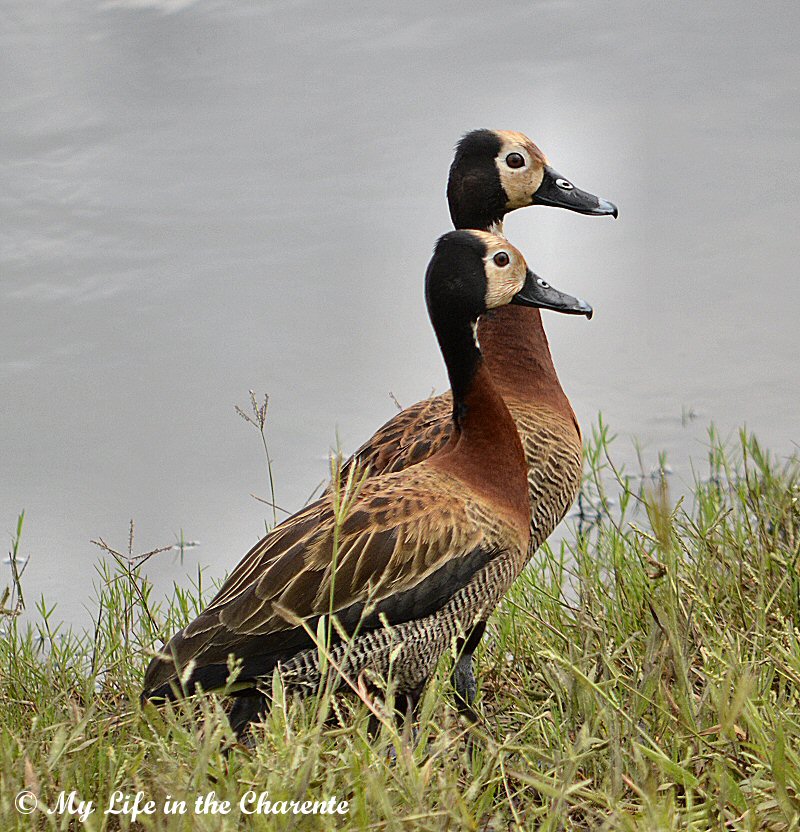
The white-faced whistling duck (Dendrocygna viduata) breeds in sub-Saharan Africa and also in much of South America. At night, the birds fly to foraging areas to feed on a varied diet that includes grass, seeds and aquatic molluscs, by wading, swimming or diving.

The yellow-billed oxpecker, (Buphagus africanus), is from the starling and myna family. It feeds exclusively from the backs of large mammals, eating ticks and insects on their hides. As with the tick birds in my last post, it is good for the animals and provides food for the birds, a win-win arrangement!

African three-banded lapwing (previously known as a plover) (Charadrius tricollaris). It lives near water, feeding on land and aquatic insects and their larvae, crustaceans, small molluscs and worms.

As the name of the resort suggests, there are plenty of elephants to see in the open landscape. The safari tent accommodation is placed around a large waterhole, so the elephants can freely come in very close to drink and bathe; care must be taken to keep out of their way! You can see one of the safari cabins on stilts in the background. We were sitting in the relative safety of the main lodge building, taking these photos with a long lens!

As close as I ever want to get!!! Eyelashes of the African elephant (Loxodonta africana).

We each had a safari tent; here are Christelle and Patrick on their balcony. We both slept like logs while here, but Patrick was up and about in the middle of the night, and on his balcony, taking videos of elephants very close by! Brave, or a little mad, I am not sure which!!!!

Christelle, Patrick and Nigel in the heat of the day, relaxing with a cool drink....

from the bar opposite. The pool was perfect for cooling off from time to time.

The elephants mostly arrived later in the day and into the evening, looking for water to drink and to cool off in.

Getting the fire ready to barbecue our dinner. No fences anywhere here, so we were keeping a watchful eye out for large intruders; thankfully they left us alone. The elephants and all game have total freedom and can wander anywhere, which they do!

Another amazing African sunset.

The next morning, we were greeted by a glossy starling (Lamprotornis genus). There are a number of very similar starlings and I am not sure which one this is. In low light these birds appear to be almost black, but in the right light they radiate the most spectacular array of blues, greens and magenta. However, there are no pigments in the feathers that give rise to these colours. It is simply a trick of the light!

Red-billed teal. (Anas erythrorhyncha). This duck is not migratory, but will fly great distances to find suitable waters. Very common.

Rock pigeon (Columba livia). Feeds mainly on seeds, rarely eating fruits and leaves. It typically forages on the ground, usually on farmland, lawns or roads. Also very common!

Early morning stroll, having taken a bath. Note he has his trunk resting on his tusks; guess it gets a little heavy to carry around all day!

Giraffe (Giraffa) A newborn giraffe is about 1.9 meters tall (6 feet) at birth and weighs about 68 kilograms (150 pounds). Fully grown giraffes stand 4.3–5.7 m (14.1–18.7 ft) tall. Males are taller than the females. I have given more information in some of the previous giraffe photos.
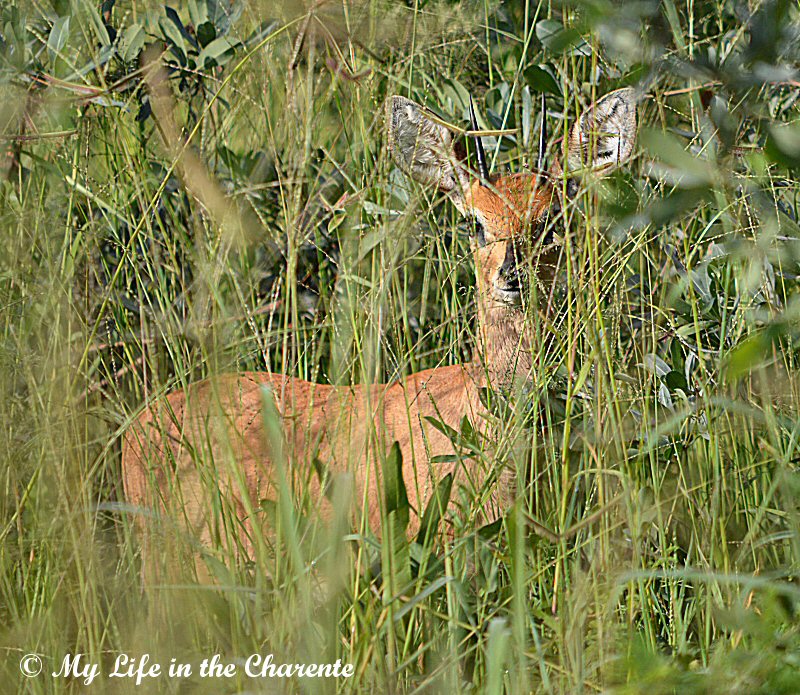
Steenbok (Raphicerus campestris). A small common antelope which is only about 60cm (2 feet) high at the shoulders. Mostly solitary but occasionally they will pair for life. Visitors will often think that they are babies as they are so small!!

Various mix of butterflies, the one with open wings is (I think) Small grass yellow (Eurema brigitta), and the white and orange one could be the Bushveld orange tip (Colotis pallene). If anyone can help with identifications, I would be delighted as I am not a lepidopterist!

The white-browed sparrow-weaver (Plocepasser mahali). Found in groups of two to about eleven individuals including only one breeding pair. One dominant male and female; the remainder are helpers! They build a number of untidy looking nests that look like a bunch of straw; inside is soft grass, feathers and woolly type material. The breeding nest has only one entrance while the roosting nests have two entrances. The babies are fed by all the birds in the colony. Co-operation at its best!
Also see my daily diary HERE