Showing posts with label Birds. Show all posts

Wednesday, 17 January 2018

A fortnight in the Caribbean - Part 1

We have friends who live on Nevis (there are twin islands - St Kitts and Nevis) and who have asked us a number of time to visit.  We though that a trip before braving the cold of the UK this past Christmas would be a good idea!  We duly booked the trip early last year, not realising that the Caribbean would be having some of their worst weather for a long time during the (summer) hurricane season.  Hurricanes Irma and Maria caused total destruction on many islands, and at one stage we thought we might never get there.  Luckily, Nevis missed the worst of it all; the damage to our friends' property was thankfully confined to their front gates being blown down and a few missing roof tiles.

We drove directly from home in France to London (Gatwick) airport  on 24 November 2017 and then the following day, we took an early morning flight to St Kitts, stopping for one hour on Antigua (where most of the passengers disembarked!).  On arrival at St Kitts airport, we were met by a taxi, which took us to the quay, where a water taxi, skimming wave crests at high speed,   carried us over the waters to Nevis in 15 energising minutes!  The taxi pilot kindly phoned ahead to our friends, to let them know we were on our way so they would be ready to meet us. Very organised!
Just to give you some idea where St Kitts and Nevis are in the Caribbean, if you did not previously know! Most of the other islands on this map were very badly affected by hurricanes and outside help and reparation is slow in arriving.

The island of Nevis, which is separated from St Kitts by a 3 km (2 miles) channel. It is only 93 sq km in size (36 sq mi) and the capital is Charlestown; you can see the "by-pass" road around the town on the West coast.

We arrived fairly late in the afternoon and the photos  taken from the ferry were not the best!

The next morning, though, after a good nights sleep, I was delighted to see many enchanting humming birds zooming around in the garden.This is a Green-throated carib (Eulampis holosericeus), motionless for just a moment!

The bees looked much the same as those we have in France!

We went for a walk through a strip of trees and bushes down to the nearby sandy beach; it was very quiet and peaceful with almost nobody else around!

Looking across the water towards St Kitts.

We spotted a hermit crab on the sand.

Back at the house, we discovered vervet monkeys in the garden - lovely to see, but they do a lot of damage!
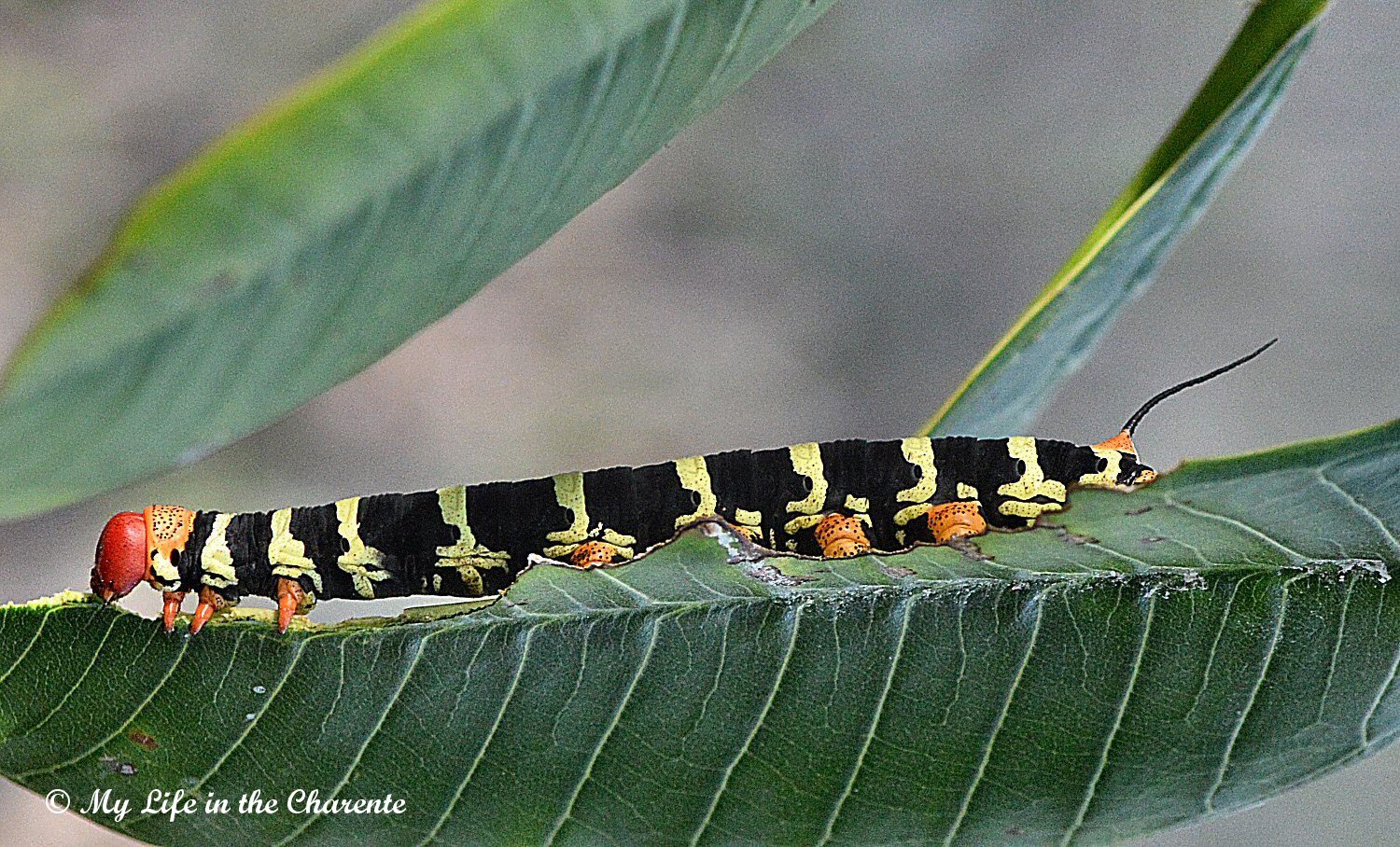
The very colourful Frangipani caterpillar (this one's 120 mm or 5 inches long), of which there were several on one plant, eats most of the plant's leaves, but we were told they actually do the plant good, as by eating the leaves, the plant's  encouraged to produce more flowers!

Lovely to see hibiscus flowering in November!

The garden was full of birds I have never seen before!; this is a Bananaquit (Coereba flaveola).

Lesser Antillean bullfinch (Loxigilla noctis) This is the male; the female is brown.

Out on our first drive around the island (maximum speed limit 40 mph!), we were told this is one of the original old houses, called a "skirt and blouse" house.  The skirt (bottom of the house) being built of stone and the blouse (top of the house) of wood.

 One of the most noticeable things we observed on the island were the many scrap cars! There is nowhere to dump them on a small island, so they are just abandoned by their owners for the vegetation to take over!

As above. There are plans for a private company to import and operate a car crushing plant, as the numbers of such cars must run into many thousands and apart from being unsightly, further damage to this beautiful tropical environment should  be avoided!

We ended up in late afternoon down at the beach, where we met up with friends of our friends, for a delightful meal of fresh fish of the day.  It was interesting to watch the storm in the distance over the sea, while we were standing on the beach, in temperatures around 30 C  (86F)

This is just to give you a first idea of our holiday.  Many more photos of the island are to come in Part 2, but due to me not feeling well,  I am far behind in the editing process!


Also see my daily diary HERE


and My Life Before Charente (updated  25 September 2016) I will get back to this eventually! 


Saturday, 26 August 2017

Part 2 of our trip to Botswana and South Africa

Apart from the the first two photos, which were taken en route to the Rhino Sanctuary, (see previous post), the remainder were taken around the Sanctuary itself, before we moved on to the next resort; I took a great many shots, so I have tried to select the better ones for these blogs! 

Just outside  Gaborone, the capital city, street vendors such as these ladies, are a common sight at the roadside. It’s also quite normal to see them in any busy location, either sitting in the sun or under an umbrella, waiting for their next customer! The people sell almost anything from drinks, snacks, fruit, vegetables and knick-knacks.  They all presumably make a living, but it must be a hard life!

Patrick, Christelle and Nigel enjoying a coffee at a small cafe in the city centre. Rich and imaginative African decorations bring life to the walls!

Next to a small waterhole, we saw these zebra and an eland (taurotragus oryx) in the foreground.   The world's largest antelope was once widespread across Africa but is now only found in protected areas, though still fairly common.  This eland looks as if it has a deformed horn but presumably that does not cause it any discomfort.


Impala (Aepyceros melampus) are very common; this is a youngster.   They both graze and browse, depending on what fodder is available; this ability to expand their feed variety helps them to be one of the most successful antelope species.


The white rhinoceros (ceratotherium simum) used to be common, but because of poaching, they are close to being endangered.  Botswana has very strict anti-poaching laws and the government is doing everything possible to look after its rhino population. Many rhino have migrated here from countries to the east, presumably because they perceive it is safer.


A springbok (antidorcas marsupialis) is one of the most  common antelopes.  Its name derives from the Afrikaans words "spring" (to jump) and "bok" (antelope).  A behavioural feature unique to the springbok is called "pronking", in which the springbok performs multiple leaps into the air with stiff legs. It looks so joyful!


A warthog (phacochoerus africanus). They are very common, and easily spotted in open areas of the bush.  I suspect this one is fairly young, as its tusks are not well developed. Warthogs have the peculiar habit of kneeling on the front knees while feeding.


Waterbuck  (kobus ellipsiprymnus) are also fairly common.  Their rump have a characteristic white ring, like a target! Only the bulls have long, forward curved horns, so these two will be  females.


Southern yellow-billed hornbill (Tockus leucomelas) are a common sight.  They feed on seeds, small insects, spiders and scorpions. They have a distinctive swooping flight and when on the ground, they hop around, looking for food.


 A Burchell's zebra foal. (equus quagga burchellii) The Burchell's zebra is the only zebra occuring in Botswana and it has been adopted as their national animal.


Brown-veined white butterfly (Belenois aurota).


Cape vulture also known as Cape griffon or Kolbe's vulture, (Gyps coprotheres)  posed characteristically in a look-out tree. They are listed as endangered, many having been illegally poisoned or shot by livestock breeders. The species usually breeds and roosts on cliff faces in or near mountains, from where it can fly long distances in search of the large animal carcasses, on which it specialises.


The crowned lapwing (vanellus coronatus) is common on open grassland.


A dung beetle, one of the 800 species in South Africa and Botswana! Unsurprisingly, I am not sure which one this is! There are four different kinds of dung beetle, named according to the way they use to move the dung. This one is known as a "roller" – it  rolls dung into these smooth, neat, round balls for use as food, or as a depository in which the females can lay their eggs. The beetles are extremely strong, capable of rolling a ball of dung 50 times their own weight!


An elegant grasshopper (zonocerus elegans).  The bright colours will let any predator know that it is poisonous.  Its toxins are ingested from the plants it eats. It probably would not be harmful to humans if eaten, but will cause problems to smaller creatures.

The european bee-eater (merops apiaster) is common.   As the name suggests, bee-eaters predominantly eat insects, especially beeswasps, and hornets. They catch insects in flight, and generally nest in burrows which both males and females excavate in earth cliffs.

The gemsbok  (oryx gazella).  Their preferred habitat is dry open grasslands.  They are fairly common and their very striking facial features and back-sloping horns make them almost unmistakable!

A giraffe (giraffe camelopardalis). They are visible from a long way off, but being the tallest animal in the world must have pros and cons!

These herbivores browse for their food supply, and have the advantage of height which enables them access to food supply other herbivores cannot reach. 

Black-backed jackals (canis mesomelas)  are fairly common.
They are opportunistic feeders, capable of adapting to most habitats and most often seen singly, or in pairs, at dusk or dawn.

Also see my daily diary HERE


and My Life Before Charente (updated  25 September 2016) I will get back to this eventually!