Showing posts with label Botswana. Show all posts

Monday, 9 October 2017

Part 5 of our African holiday - Botswana

The day following our visit to the Victoria Falls, we planned a visit to Chobe National Park, which is close to where we were staying. We had so enjoyed our evening trip on the Chobe river with knowledgeable guide Kaiser, that we arranged for him to take us on a tour of the Park. Chobe National Park is in northern Botswana near the vast, inland and spectacular Okavango Delta - we still have to get to that :-)! The park  has one of the largest concentrations of game in Africa. Apologies for the long post, but I did not want to split the viewing of one day into two!
Here is Kaiser collecting us from our hotel. Candy from the hotel on the left making sure all is in order, with Christelle, Nigel and myself.

A few interesting details about the park. It is one third the size of Belgium!

A baby elephant, closely minded by Mum; you can see her just behind on the right.


An obviously young elephant, with characteristically small tusks. (Loxodonta africana). 

The magnificent African fish eagle (Haliaeetus vocifer). 
It has the most amazing, haunting, spine-tingling call, which you can hear at this link


Banded Mongoose (Mungos mungo)
Banded mongooses are sociable creatures and are found in troops of up to fifty individuals. The sizes of their territories or home ranges depend greatly on the availability of food and the conditions of the area. The food of these animals includes a diversity of creatures such as insects, small reptiles such as lizards, amphibians and birds and their eggs. They also take small rodents and scavenge at times.

Blacksmith lapwing, which used to be called a blacksmith plover, but has fairly recently been renamed!  (Vanellus armatus).

African (also known as a Cape) buffalo (Syncerus caffer) with cattle egrets (Bubulcus ibis); they are a species of heron. The cattle egret removes ticks and flies from cattle and wild animals.  Good for the animals and food for the birds, a win-win arrangement!

A closer view of a buffalo. They can be quite dangerous, so a telephoto lens is essential!  Possibly a male as it appears to have quite a large "boss", which is the heavy part in the centre of the horns.

Southern carmine bee eater (Merops nubicoides)  with striking and very distinctive pinkish-red plumage. They often nest in earth banks.


There were many flame lilies around in the park (Gloriosa superba). It is the national flower of Zimbabwe.


Giraffe (giraffe camelopardalis). In open areas of the countryside, they are visible from a long way off, but surprisingly well camouflaged in areas of denser vegetation as above. Being the tallest animal in the world must have pros and cons as mentioned in Part 2!

Hamerkop (Scopus umbretta).  Hamerkop means "hammer head" in Afrikaans, so it is quite obvious where the name comes from! They build massive, unmistakable, nests in  trees, mainly from sticks. A fairly nondescript brown bird, but it has a number of superstitions attached to it.  It is also known as the  Lightning Bird for the belief, in some cultures, that people who tamper with its nest will be struck by lightning!  Some African people believe that if a hamerkop flies over your home, the abode has to be burnt down or bad luck will follow.  The hamerkop feeds predominantly on tadpoles and adult frogs, fish and some insects.  Beware if you have a goldfish pond at your home, as my mother found out - the hamerkop appears to love goldfish as well!!

Hippo (Hippopotamus amphibius) are semi-aquatic and found by rivers, floodplains and swamps. The deep grunting of hippos is one of Africa's characteristic sounds. Although they are grazers, hippos are blessed with massive teeth that are used in territorial fights and displays. They are renowned for their aggressive, territorial nature and they are one of Africa’s most dangerous animals! As described in part 3.

 Helmeted guineafowl (Numida meleagris).  Insect and seed-eating, ground-nesting birds .

Greater kudu (Tragelaphus strepsciseros) females.  Sadly, we did not see any males; they are very beautiful with their long spiral horns.  Kudu live mainly in thick vegetation and are not easy to see.  They are browsers, but will eat grass, berries and pods if the need arises.

Lilac-breasted roller (Coracias caudatus).  It is a spectacularly coloured bird, with a lilac throat and breast and blue belly. It has long, straight outer tail streamers.  For nesting, they use natural tree cavities and large woodpecker holes. Their food consists of a variety of locusts, grasshoppers, crickets, beetles, butterflies and lizards.

The Chobe River area is one of the few areas in Botswana where the puku antelope is found. (Kobus vardonii) Shoulder height 80cm. Weight 60–75kg. Easily confused with the lechwe at a glance, the puku has an orange-red colour overall, which is lighter underneath than above. However, puku are found all over east and central Africa, and are one of the most common antelopes in Zambia. Typically, they inhabit open areas near rivers and marshes, though in Zambia are found in a wide variety of habitats.  Thanks to Kaiser who identified the antelope for us.
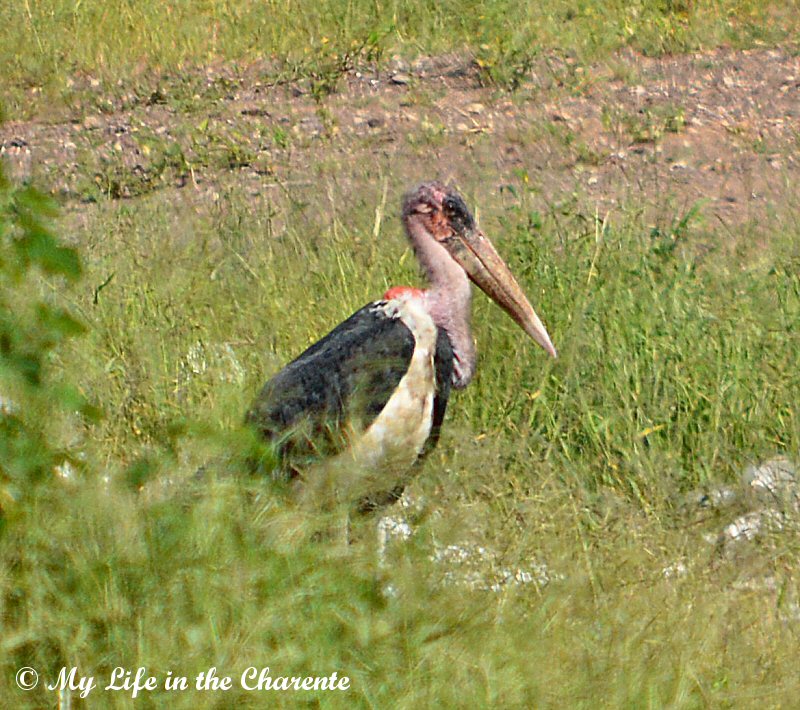
Marabou stork (Leptoptilos crumenifer).  Not the most attractive of birds(!), it is sometimes called the "undertaker bird" due to its shape from behind: cloak-like wings and back above skinny white legs.  Deceptively large, it has a wingspan of up to 3.7 m (12 feet!).  It eats mainly carrion, scraps and faeces, but will eat almost any animal matter if it can swallow it!

Ground squirrel (Xerus inauris) Shoulder height 20–30cm. Weight 400–700g.
This terrestrial rodent is common in the more arid parts of Botswana, including the central Kalahari, and southeastern areas.

 Southern red-billed hornbill (Tockus rufirostris). The female protects her young against intruders by building a mud wall across the opening of her nest. She then seals herself in and brings up her chicks in a 'prison'.  Presumably this is a male bringing food to its family, passing the tasty morsel through a small crack in the mud screen.

 Wahlberg's striped skink (Trachylepis striata wahlbergi) .  They grow up to 25 cms  (9.8 ins) in length.

Fork-tailed drongo (Dicrurus adsimilis).  A very common, easily identified bird in southern Africa; it mainly lives on small insects.

This was a very patient bird; as you can see, as it allowed me to get quite close!


Also see my daily diary HERE


and My Life Before Charente (updated  25 September 2016) I will get back to this eventually! 

Sunday, 24 September 2017

Part 4 of our African holiday - Botswana, Zambia and Zimbabwe all in one day!

Following on from the last African post, we planned a day to go to Victoria Falls.  Candy (see part 3) booked the trip for us and we were collected at the hotel and taken to the Kazangula ferry. Here we are on the Botswana side of the river!
Kazungula is a small border town in the southern Province of Zambia, lying on the north bank of the Zambezi river about 70 kilometres (45 miles) west of Livingstone. At Kazungula, the territories of four countries (Zambia, Botswana, Zimbabwe, and Namibia) come close to meeting up.  The ferry is a fairly basic, old and rattly, used-for-years pontoon which traverses the river, which is 400 metres (1,300 ft) wide at this point.


A bridge is being built by an Asian company at a cost of US$234 million and construction commenced in December 2014   It is expected to be completed in December 2018.  At present all transport, including very large transcontinental trucks,  has to cross by ferry.  There have been several accidents, sinking of ferries and unfortunately, many lives lost.  The bridge will make life very much easier for business, residents and tourists, but I assume that tolls will be levied to recoup that $234 million!

You can see here the size of those trucks and their double-trailer loads; the ferries are usually overloaded and extremely low in the water,  so accidents can be expected! We were foot passengers, along with many locals, all of us hoping we wouldn't end up swimming!

Arriving in Livingstone, Zambia after a one hour trip in a minibus on a smooth tarmac road. Unfortunately it was raining, and although we were driven around and shown the sights, it was not good weather for photos!


I did get a passing shot of Livingstone High Court.


By the time we reached the magnificent Victoria Falls, the rain had stopped.  Not that it would have made much difference, as due to the spray we got soaked anyway!  It is not surprising that the local name for it is Mosi-oa-Tunya  meaning "the smoke that thunders"  I have seen the falls previously from the Zimbabwe side, but I think they are even more dramatic from the Zambian side.
While it is neither the highest nor the widest waterfall in the world, Victoria Falls is classified as the largest, based on its combined width of 1,708 metres (5,604 ft) and height of 108 metres (354 ft), resulting in the world's largest sheet of falling water. 

David Livingstone, the Scottish missionary and explorer, is believed to have been the first European to view Victoria Falls on 16 November 1855.  He named the falls after Queen Victoria, but Mosi-oa-Tunya remains the local popular name. His meeting on 10 November 1871 with Henry Morton Stanley, a journalist and explorer who went to look for him,  gave rise to the popular quotation "Dr. Livingstone, I presume?"

We were being scrutinised carefully while walking around.  If you ignore them they will generally ignore you.  It is not wise to try to feed them, (or any wild animal for that matter); baboons have massive teeth which are like knives.  I have seen (I used to work for a vet) the damage that they can do to large dogs- not pleasant.  
Chacma baboon (Papio ursinus).

Impossible to get the whole falls in one photo, even with my wide angle lens!


Fluttering around in the trees was  a paradise flycatcher (Terpsiphone viridis).  This has to be a female, as the male has a very long tail!
  
Nigel and I standing at the back of the falls;  you can see its cloud of spray in the distance behind us.


Victoria Falls bridge. The siting of the bridge came under huge criticism, as it was felt that it would intrude on the natural beauty of the gorge and detract from the Falls themselves, but many years later, opinion softened after the bridge structure was hailed as one of the finest achievements of Victorian engineering and design.

The Victoria Falls bridge was a crucial link in the route of a railway running the length of Africa, the planning of which the famous Cecil John Rhodes envisioned.

To ensure accuracy in the manufacture, the bridge was assembled in sections at the Cleveland Bridge Company factory yard in Darlington, England before being shipped to Africa.

The main arch of the bridge was joined on 1 April 1905.  The two centre girders of the arch were in place by sunset 31st March, but they overlapped to the extent of about 1 ¼ inches.  When work started at sunrise next morning, it was found that the bridge had contracted during the night to the extent of exactly 1 ¼ inches.  The two centre girders had dropped into place and fitted perfectly!!

The official opening ceremony took place on 12th September 1905.   Sir Charles Metcalfe, an engineering friend of Rhodes, made a welcoming speech to declare the Victoria Falls bridge was officially open.

“I should like to have the spray of the water (of the Victoria Falls) over the carriages.” – Cecil John Rhodes

My shot of a bungee jumper from the bridge - he survived!; it seems to be a very popular pastime. There is a 111m (364ft) drop on the bungee, falling almost into the Zambezi River. They are very welcome, but I would much rather watch!!

Seen on a rock just off the path- Variegated Skink (trachylepis variegata).

Our driver kindly drove us over to Zimbabwe and had a chat to the customs officers there. We were were allowed out of the car, so we could walk back to Zambia across the bridge!

Nigel, Patrick and Christelle crossing the bridge. Nigel was still trying to stay dry, with a raintop over wet t-shirt and shorts (!). I guess Christelle and Patrick had given up !

Nigel and I on the bridge, looking rather under-dressed in the swirling spray!

Driving back to the hotel - a little memento from near the Botswana border.

Baobab tree. (Adansonia digitata) It is a tree from prehistoric times, that can live, so they say, for up to 1,500 years. They vary in size, up to 30 metres (99 feet) in height and 11 metres (36 feet) in diameter, and this one is at the larger end of the scale! Baobab has the only fruit in the world that dries naturally on its branches. Instead of dropping and spoiling, it stays on the branch and bakes in the sun for 6 months - transforming its green velvety coating into a hard coconut-like shell. The pulp of the fruit dries out completely and that when processed is what we know as "cream of tartar"!

and here's an interesting sky  under which to sit, relax, observe and drink a glass of great South African red wine! Like this.....


Cheers!!


Also see my daily diary HERE


and My Life Before Charente (updated  25 September 2016) I will get back to this eventually! 

Thursday, 7 September 2017

Part 3 of our trip to Botswana and South Africa.

We spent some time the next morning driving around the Rhino Sanctuary  (see Part 2) before going back onto the main road and heading for Chobe National Park, situated along the Chobe river in northern Botswana. The park is the third largest park in the country.
Crimson-breasted Gonolek or Crimson-breasted Shrike  (Laniarius atrococcineus).  A  very striking bird which is unlikely to be confused with any other species. The male and female both have brilliant crimson chests.  They feed on small insects and fruit.


Grey Loerie (Corythaixoides concolor) which is now officially called the Grey Go-away bird.  It is named for its alarm call, "Kuh-wê!", which sounds like 'Go Away!'
So many birds have recently had name changes.  Something to do with International naming and I must admit to being more that a little confused, after so long with the old names!   


Tsessebe (Damaliscus lunatus lunatus). They are grazers and prefer feeding on new shoots. The tsessebe are often found with other species such as zebra and wildebeest. Generally, there is no competition for food, as all three species prefer different parts of the plants they feed on. They are also the fastest antelope in Africa.


As stated in my previous post, the white rhinoceros (ceratotherium simum) used to be common, but because of poaching, they are close to being endangered.  Botswana has very strict anti-poaching laws and the government is doing everything possible to look after its rhino population. Many rhino have migrated here from countries to the east, presumably because they perceive it is safer.

Shaft-tailed whydah (Vidua regia). This is a male in breeding plumage, easily recognised by the long thin tail feathers with broadened ends.

Giant African bullfrogs (Pyxicephalus adspersus) are the largest amphibians found in Southern Africa. Males can reach a body length of 245 mm (9 ½ inches) and a mass of 1.4 kg (3 lbs).  They can also be quite aggressive as my father discovered some years ago, when he put his foot out towards one. Luckily he had good shoes on, as the front of the size 10 shoe almost vanished from sight into its mouth!!!


Blue wildebeest (Connochaetes taurinus)  This ungainly antelope, is also called the brindled gnu. The gnu was made famous in the 1950's by Flanders and Swann, who sung a popular comedy hit entitled "I'm a Gnu!!"  Here you see adults with their young.

We had booked to stay at River View Lodge, a fairly small and exclusive development, situated right on the bank of the beautiful Chobe River in the Kasane region of Botswana.  Our host was the delightful Candy, who made our stay there an absolutely unforgettable pleasure, including arranging all our trips for us.  Not only in this post, where were treating ourselves to a private "booze cruise" on the Chobe river, but also, as you will see in the next post, to take a trip across to Zambia to see the mighty and magnificent Victoria Falls.

Out in the cruise boat in the late afternoon, we saw this young elephant doing its very best to keep up with its mother.... There are no fences here and the wild animals wander at will anywhere they like. Often you will find an elephant right in the centre of the road.  It is best to just stop and wait for them to move out of the way.  BUT beware, if the trunk should go up and their ears flap while looking in your direction, reversing at top speed is advisable! They can be very dangerous!


This one was having great fun playing in the river.


An unlikely meeting, a young elephant showing off and approaching an African (also known as a Cape) buffalo. (Syncerus caffer).  I was sorry I did not take a video, as the buffalo was not at all concerned, but trotted off with the young elephant triumphantly chasing after it!


We had a very light shower of rain while out in the boat, as this faint rainbow shows.


Getting a little too close for comfort!
Hippo (Hippopotamus amphibius) are semi-aquatic and found by rivers, floodplains and swamps. The deep grunting of hippos is one of Africa's characteristic sounds. Although they are grazers, hippos are blessed with massive teeth that are used in territorial fights and displays. They are renowned for their aggressive, territorial nature and they are one of Africa’s most dangerous animals!


Feeding on the river banks.


Luckily for us, Kaizer, our guide out on the boat, knew exactly what he was doing and kept us far enough away from any risky situations.  His knowledge of the animal and birdlife was incredible and impressive; he not only identified each and every one we saw, but also informed us about their habits and behaviour.  We all learnt a lot from him!


The first time I have seen a Lechwe (Kobus leche).  They need dry land on which to rest, but are otherwise adapted for life in the seasonal floodplains of Botswana. They have elongated hoofs to adapt to the mud of their habitat, and the hind quarters are larger and more developed than the front to assist when running through the water.


African Sacred Ibis (Threskiornis aethiopicus).  Its diet consists largely of insects, although it will also take crustaceans, worms, fish, frogs, lizards and small mammals.  It will also take eggs of other birds and crocodiles!  Brave bird! The nest is a large platform of sticks and branches built in trees or bushes, or placed on the ground on rocky islands.


Returning to River View Lodge; the accommodation was much more comfortable than our night at the Rhino Sanctuary, but both locations offered experiences we all thoroughly enjoyed!


Nothing beats the setting African sun!


As above.


Back at the comfort of the lodge, Diane, Nigel and Patrick having a coffee .... and I am sure a glass or two of excellent South African wine as well!

....while listening to the restful sounds of a  Cardinal Woodpecker (Dendropicos fuscescens) tapping away at a tree close by.


Also see my daily diary HERE


and My Life Before Charente (updated  25 September 2016) I will get back to this eventually!