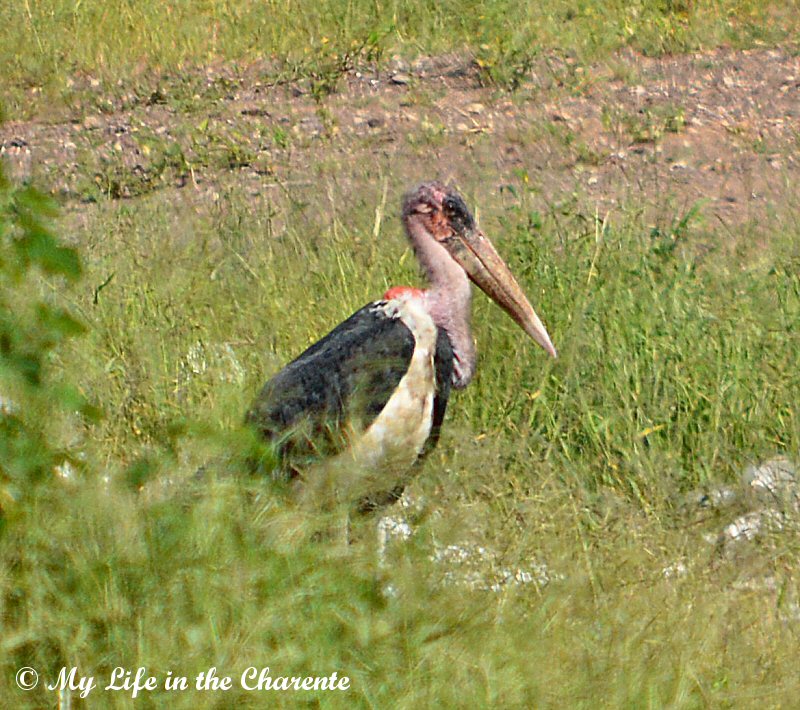
We left Joan's place on the south coast to drive up to Pietermaritzburg, where we were meeting my great friend Gordon, who I have known for at least 50 years, although I hate to admit it (!). We first met when we both worked at the Veterinary Research Laboratory in what was then Salisbury, Rhodesia.

Driving along the scenic south (of Durban) coastal road, almost all one sees are endless fields of sugar cane. South Africa produces 19.9 million tons of sugar cane a year, and most of it comes from the rolling green valleys of KwaZulu-Natal. If you should be interested you can find more about it HERE; it's an interesting site.

This drive was quite short; after the one in Part 7, just a short hop! A relaxing drive of 2 ½ hours, mostly on dual carriageways, in light weekend traffic brought us to Pietermaritzburg. We had a day's rest there, before we were again back on the road with Gordon and his partner Julie, heading for Gordon's sister's home near Empangeni.

The amazing views driving through the "1000 hills" of Kwa-Zulu-Natal.

Arriving at Empangeni, we discovered that Gordon's sister Heather and brother-in-law Eric have the most amazing hillside property situated in a private game park! We sat on their elevated balcony, with a beer in hand, watching these giraffe at the bottom of the garden! There are very few places in the world where you could experience this sort of life!

Walking around their unfenced garden, keeping an eye out for large wild animals (!) , I saw this Long-tailed Blue butterfly (Lampides boeticus)...
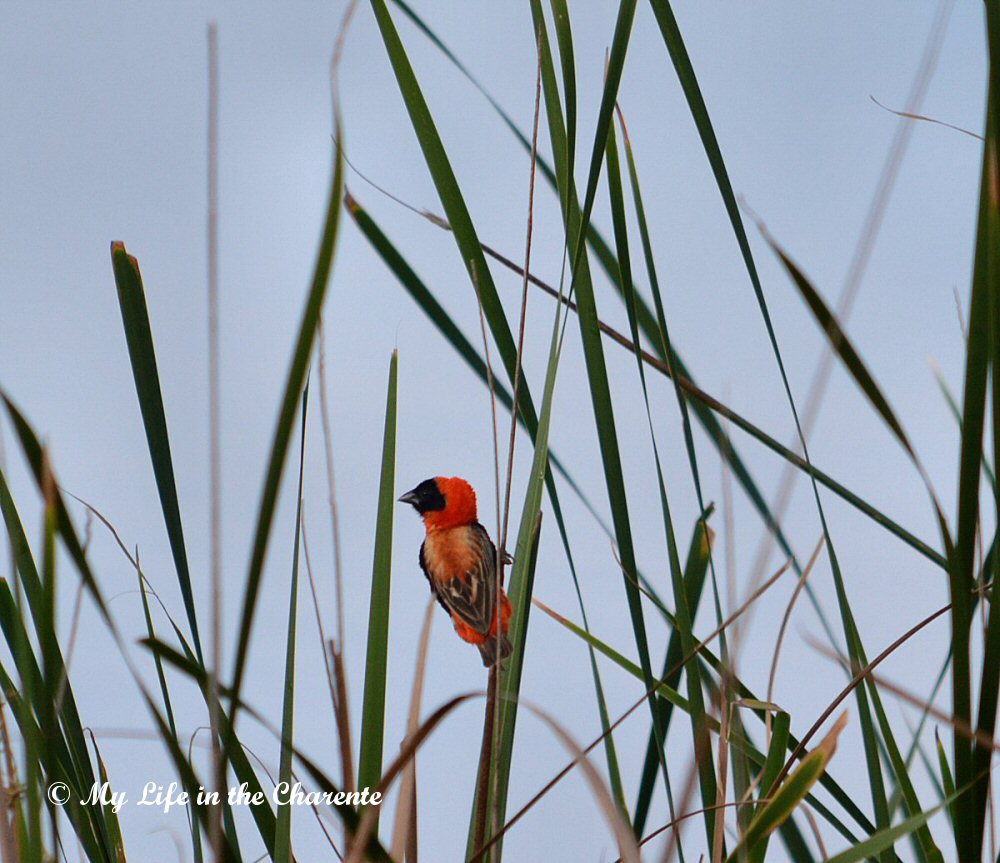
and a Southern red bishop bird (Euplectes orix). This was one of the birds that was on my wish list to see again (I love them) and this was the only one I saw!

After a drink on the balcony, we all headed down to the riverside to have an evening braai (better known outside Africa as a barbecue!). The fire was behind the cold box (sorry) but it was one of the few photos I had of Julie, Gordon and Nigel all together in the centre of the photo, with Eric seated on the right.

Meanwhile, in the river right behind Nigel and Gordon, were these very noisy hippos. (Hippopotamus amphibius). As I have mentioned before, the world's largest, angriest animal, and one of the most dangerous. There are no lion around these parts, but you need to be watchful for the occasional leopard, which I regret we did not see!

Moving onwards the following day and heading on to Bush Baby Lodge (owned by friends of Gordon) for the night, we saw this bird of prey, an African harrier-hawk, or gymnogene (Polyboroides typus) as it is better known. Gordon is an exceptional wildlife spotter, amazing at sightings and identification, a talent which made our lives very easy!

Stopping along the way for a meal; all "mod cons" in Gordon's Toyota 4x4 and that extra bit on the roof is a tent!!

Nigel and Julie at the back of the vehicle. The box on the left is a deep freeze/ fridge combination; very useful when travelling in the bush!

We spent one night at Bush Baby Lodge (just off this map, but would be top right, beyond where Memorial Gate is shown), then the following day driving though Umfolozi and Hluhluwe game reserves.The whole of Kwa-Zulu Natal province is shown at top left on the map with large scale detail of these game reserves. There had been a lot of rain in the area and game watching on the unsurfaced bush trails in a 2-wheel drive was definitely not recommended!

A cicada seen at Bush Baby Lodge. There are about 150 different species in South Africa, so I am not going to try to identify it further! They are extremely noisy; the high-pitched song is actually a mating call, belted out by the males. The sound is very complex and if you want to know how they make it, then click HERE which should help you to understand!

During the day, we saw few larger animals but lots of birds. Here is a European roller (Coracias garrulus) wintering in Natal. It will head back to Europe to breed in summer.

Impala (Aepyceros melampus) making a face 😉 I guess really it is chewing its food. The impala is able to change its eating habits with the seasons, depending on what is available in the near surroundings. Impala like to graze on fresh grass, but will also nibble on shoots and foliage when there is no grass growing nearby.

Two very young Zebra foals. (Equus quagga, formerly Equus burchelli). Apparently no two zebras are the same; their stripes come in different patterns, unique to each individual.

Mocking cliff-chat; male. The female is brown. (Thamnolaea cinnamomeiventris). This bird inhabits rocky and boulder strewn areas, well-wooded rocky ravines, and watercourses in valley bottoms with scattered rocks. Mainly insectivorous, but they also eat fruit, and feed on the nectar of aloes.

Pied crow (Corvus albus). It is a monogamous bird, which means that the bird finds and breeds with one partner for the rest of its life. The bird lays between 1 to 7 eggs, which are green in colour. The nest is built high up in the tree canopy and is protected from predators by branches and the dense green foliage. They are cheeky birds and can be quite noisy.

Spotted thick-knee also known as the Spotted dikkop or Cape thick-knee, (Burhinus capensis). This bird can reach up to 45.5 cm (17.9 in) in height, has long legs and brown and white speckled plumage which provides fantastic camouflage. It hunts and nests exclusively on the ground, feeding on insects, small mammals and lizards.

Steppe buzzard (Buteo vulpinus) which is a migratory bird of prey and one of the most common species of raptor in southern Africa during the summer months.

African or Cape buffalo (Syncerus caffer) cooling down in a mud puddle. Due to the heavy rains, there were plenty of those around.

Not the best photo, but the only one of a tortoise that I managed to get! I am not certain which one this is, but several of the species are critically endangered. I feel I was lucky to get any photo at all.

A warthog family (Phacochoerus africanus). Although covered in bristly hairs, their bodies and heads appear largely naked from a distance, with only the crest along the back, and the tufts on their cheeks and tails being obviously haired.

A white rhino, also cooling off in a small mud puddle, When the mud is dry, the animal will scratch itself energetically against a tree stump or trunk to get rid of parasites. Rhinos also wallow in mud to protect their skin from the sun and to cool off.

A yellow-billed kite (Milvus aegyptius), another of the most common birds of prey on the African continent.

Banded groundling (Brachythemis leucosticta) is a common dragonfly that occurs over most of South Africa.

Not a sign often seen, particularly outside Africa 😊. The "big five" game animals are the lion, leopard, rhinoceros , elephant, and Cape buffalo as seen here and all can be dangerous!

European bee-eater (Merops apiaster). This bird breeds in open country in warmer climates. As the name suggests, bee-eaters predominantly eat insects, especially bees, wasps, and hornets, which they catch in flight. Before eating a bee, the European bee-eater removes the sting by repeatedly hitting the insect on a hard surface.
Still more African images to come, as Gordon takes us further into the delights of the KwaZulu-Natal game parks.