Showing posts with label mairie. Show all posts

Monday, 12 June 2017

Talmont-sur-Gironde and the Gallo-Roman site of Le Fa.

Talmont-sur-Gironde is a small commune in the department of Charente-Maritime in southwestern France, on the eastern side of the mouth of the wide Gironde estuary.

The enclosed and fortified village, situated on a peninsula, was founded around a church in 1284, according to orders issued by  Edward I of England, who  controlled that part of France at that time. The church (of which more later), then about 200 years old, was the only building  standing in that isolated spot. The village became a focus for pilgrims journeying from the north of France to Santiago de Compostela in northern Spain. It survived the long wars of the Middle Ages, but in 1652, it was destroyed by the Spanish and had to be rebuilt!

An aerial shot of Talmont as it is today, photo copied from a post card, as I don't have a drone!! The ancient church and its cemetery can be see on the cliff edge, to the right.

A photo of the lovely B and B where we stayed, taken from the other side of a watery inlet.

One of the narrow traffic-free streets of the village, which is on the list of the most beautiful in France. It's a real tourist destination in summer and many of the little houses have been converted into shops and cafes.

I was fascinated by this magical water tap!

The Mairie (Mayor's office), a focus in every French village.

An interesting doorway, formed with old dressed stones no doubt "liberated" from older, grander, residences which haven't survived!

An old religious artefact recovered from a grander building and thoughtfully incorporated into a restored wall  of one of the village houses.

The church dedicated to Sainte Radegonde, a 6th century religious figure, was built in 1094.

Simple stonework inside the church.

An ancient arch or doorway. Moving on, we arrive at Le Fa..........

What some scholars think might be the town of Novioregum, or Le Fa as the French now call it in the absence of complete proof as to its identity, is in the present day commune of Barzan, very close to Talmont. The extensive archaelogical excavations started in 1975 have revealed a small town, considered to be one of the most important Gallo-Roman trading ports on the Atlantic coast. The Roman stone walling at the base in this photo formed the foundations of an ancient Roman temple called the Sanctuary.


The ruins of a windmill built on the old Roman base. The whole town seems to have been razed to the ground some time in the 4th or 5th centuries A.D., the remains being buried in sand dunes and lost to memory.


Excavations revealing walls forming the rooms of the thermal baths. More excavations are in progress with the hope of uncovering relics which might identify the mystery town.

A reconstructed hypocaust - Roman underfloor heating! Hot air from a nearby fireplace, stoked with wood by slaves, was channelled through the underfloor cavity, warming the stone floor slabs on its way.

An oven used in the manufacture of ceramics, partly restored.

Reproduction of an original mosaic found in the the Roman villa at Séviac, further south in  France.

Tuesday, 30 May 2017

Exploring Pons

Pons is a small picturesque town of about 4,000 people, set in Charente-Maritime (department 17) in south-western France.  The town originally developed because of its position on one of the important pilgrimage routes which followed Roman roads to Santiago de Compostela in northern Spain. Pons is on one of 4 such roads which start from Paris; however today it doesn't seem to be faring so well, with unemployment recently given at over 16%. It sits on the many-channeled and meandering Seugne river, which is used for boating and other outdoor activities.
Pilgrims negotiating a roundabout! The town makes a lot of its pilgrimage history and there are various tourist trails to explore.


One of two important churches in Pons, the first is dedicated to St Vivien and was built in the 12th century to the romanesque style, but rebuilt 300 years later using some of the original stonework. You can see that plenty of money was spent on  the impressive carved frontage, while the other sides were simpler and cheaper. It's situated just to the left of the roundabout in the first picture!


Inside we see this arty mosaic of uncertain age, depicting a pilgrim of the time making his way to some far-off religious destination, no doubt.

A front view of the old chateau, which has now been put to new use as the mairie. An original chateau was destroyed in  1179 by Richard the Lionheart as a consequence of a rebellion by some of his subjects, but was rebuilt in 1187. It survived until 1621, when Louis XIII's army destroyed it while laying siege to the town. "Several years later", it says, Cesar d'Albret, a french marshal and lord of Pons, had it all rebuilt. Lots of work for builders in those days, then!


Part of the ramparts around the chateau. You can observe the steep drop behind the chateau/mairie, allowing people who sought shelter in the chateau on the high ground to have a good view of any bad guys approaching! Next to the chateau is the donjon (castle keep) to be seen a bit later.


Times must have changed for the better in the 17th century, so presumably there were fewer bands of brigands roaming the land and little need for defences, so the aforesaid Cesar d'Albret might have said to his builders "while you're rebuilding the chateau, can you pop on a "grand escalier" (great staircase), because I need to get  men and materials as fast as possible up to the top to lay out some orchards and landscaping!!" This photo shows only part of the huge piece of work, which links the chateau level with that of the lower town far below and must also have been designed to impress his guests!


A donjon (castle keep) is a fairly standard feature of medieval chateaux (castles) and provides a high security area for the lord, chosen others, food and water in which to shelter during attacks and sieges. This donjon, 33 metres high was built along with the chateau in the 12th century and remains to this day, untouched by the sieges and wars in the intervening years! We were there at lunchtime, so as usual the place was locked up and we couldn't look round it!


Another view of the esplanade (the old chateau inner courtyard), showing the donjon, the mairie behind left, and in front, a monument to Emile Combes, an 19th century local doctor and long-time mayor.

His grand and elaborate monument leads us to believe he was held in high regard by the townspeople and reading his biography, one can see why they felt that way. Mayor of Pons for 43 years, Combes also became a French senator in 1885 and was involved in the political renewal in the country which led to laws separating the Church from the State.

The arched entrance way and entrance doors of the Hôpital des Pèlerins (Pilgrims' Hospital). The ancient cobbled street is lovely, but, yes, you guessed, it was lunch time and the place was shut!

The main entrance archway. If you look carefully at the stonework, ancient graffiti made by the pilgrims of old has been preserved in the restoration works.


A lovely little turret in an unassuming back street caught my eye. You can only wonder who put it there and why?! To see down the street maybe, but it was an expensive way to do it!


The "ruelle des arcades" (walkway of the arches) takes the walker from chateau level to a point much higher up the slope. Quite a puff! The arch is only about the height of a medieval man - 1.65 metres or 5 feet 5 inches.


The chapel of Saint Gilles is now the archaeological museum, but more importantly it is about the last vestige of the original 12th century chateau complex (apart from the donjon). The chapel is built on top of a Roman vaulted passage mentioned in ancient documents.

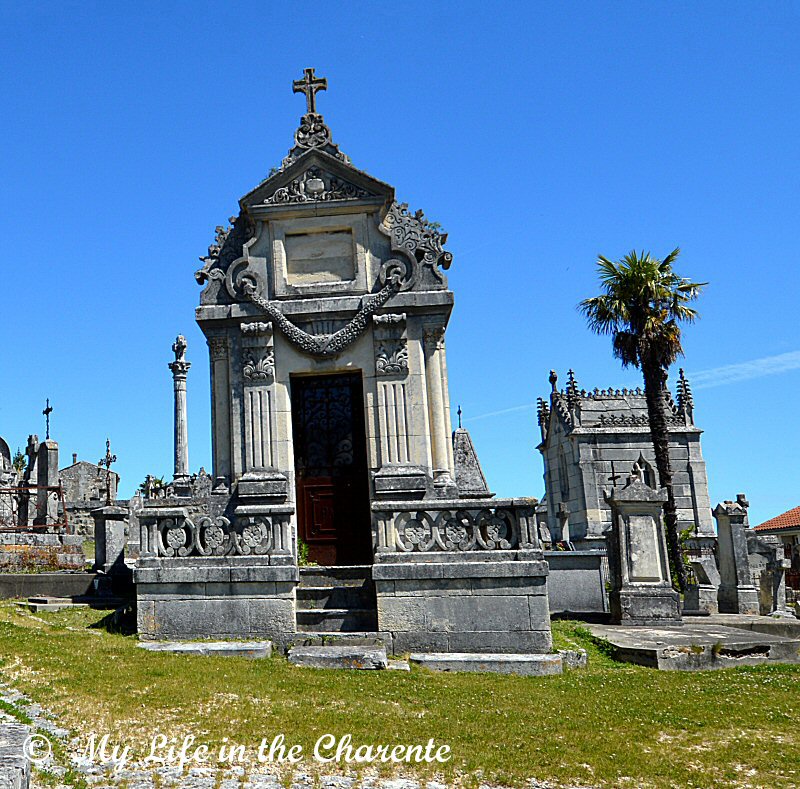
Very elaborate burial vaults in the old cemetery on top of the hill overlooking the chateau.

Ghost sign - Antar is a former French petroleum company, founded by Pechelbronn SA in  Alsace in 1927, but its origins go back to 1745 when oil wells were drilled in the vicinity. Never knew there was oil in France! Antar has been gobbled up by larger companies, but the name lives on in 'Antargaz' which is a current bottled LPG product. Interesting company history!

The other large church in the centre of Pons is Eglise Saint Martin, and it fills one side of a shady and quiet tree-lined square. A Turkish kebab shop sits rather uneasily on another side!

Beautiful stained glass window in that church. It seems to be illustrating the "miracle of a pine tree".


Also see my daily diary HERE


and My Life Before Charente (updated  25 September 2016) I will get back to this eventually!